How Do Cars Not See Motorcycles In North Carolina?
Key Highlights:
- Understanding how do cars not see motorcycles can be attributed to the brain science, but a driver’s limited vision filter can not be a good reason to justify an accident legally.
- Statistics show that more than 42% of car-bike accident situations result from a left turn by the car driver who was looking only for big vehicles.
- As a strict contributory negligence legal policy in North Carolina, any blame, even as little as 1%, would disqualify a rider from claiming financial compensation from the crash.
- Motorcycle accident claims can be resolved based on evidence provided by camera footage, data, and scene mapping of what was actually visible, not by what the driver claims they saw.
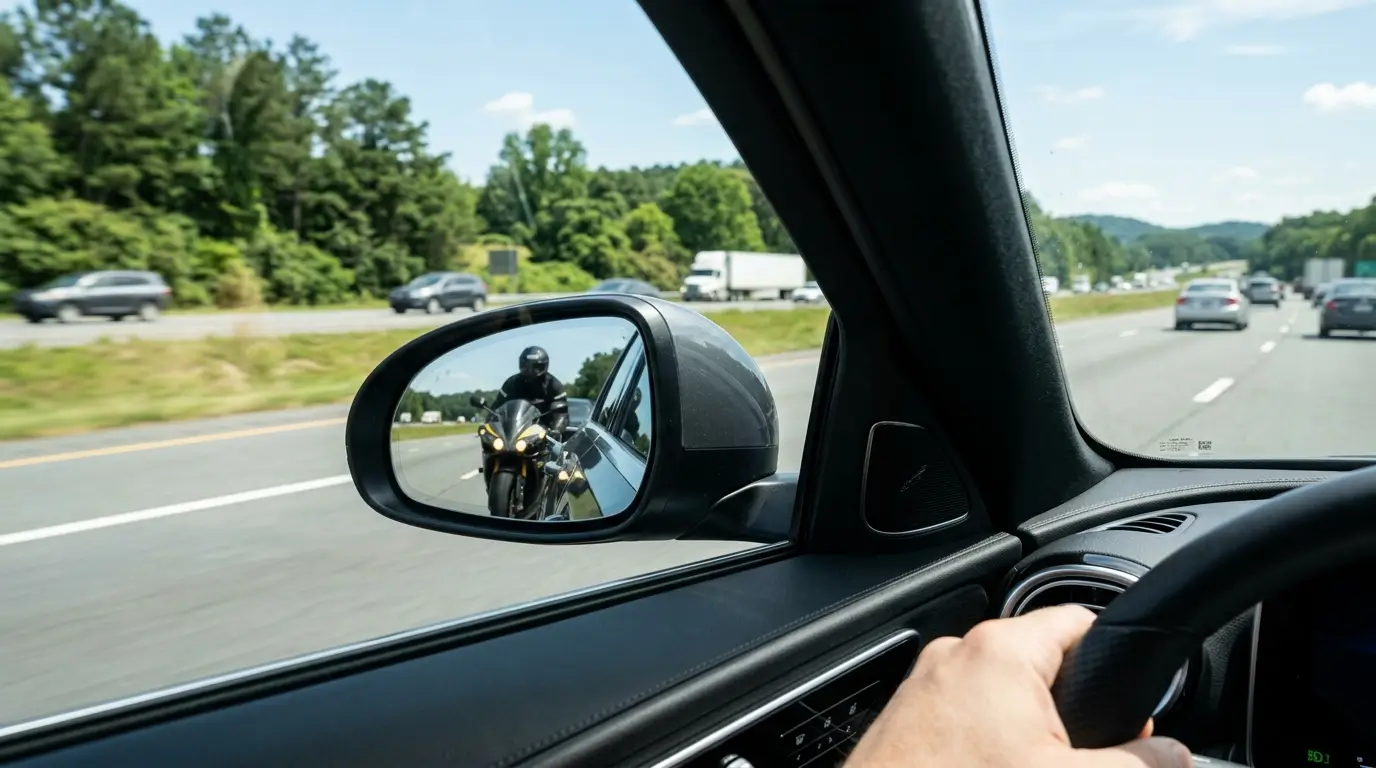
In the aftermath of most accidents, the common excuse from drivers is, ‘I just couldn’t have seen the bike at the time.’ Understanding how do cars not see motorcycles is related to cognitive science: a driver may visually fixate on a bike, but their brain is just going through filtering mode and ignoring it without actually seeing it.
Even if they do have that excuse, they still shouldn’t have driven recklessly. Per North Carolina laws, drivers must keep a proper lookout, and this duty defines the fault based on what a reasonable driver should have seen in the same situation. Our lawyers at Tatum & Atkinson Law Firm don’t let the driver shift responsibility on the basis that they just didn’t see you.
If you have been in a motorcycle-car crash, contact our motorcycle injury lawyer NC today at (800) 529-0804 for a free consultation.
What a Motorcycle Looks Like From Behind the Wheel
To gain a better understanding of geometry, let’s examine how a car is a large rectangle of metal. Because a motorcycle is nothing but a slim vertical sliver, these shapes are very unhelpful to drivers who must guess the speed difference.
When a car approaches, it becomes bigger in the driver’s windshield, resulting in a faster speed perceived due to an increase in the dimensions of the object. Conversely, a motorcycle’s shape barely changes in size, which makes understanding the speed difficult.
Looked, But Did Not See
Perception is actually more problematic than eyesight. The mind sorts out information, concentrating on what it thinks it should see. As vehicle operators approach an intersection, they tend to think about larger automobiles and ignore motorcycles. This is referred to by researchers as inattentional blindness, a term that indicates that the driver failed to see motorcycle, commonly known as “looked-but-failed-to-see”.
Expectation bias compounds the problem. The operator who drives out of the same parking space every day will subconsciously be searching for familiar shapes of vehicles on the roadway. Because of a motorcycle’s relatively smaller size, the operator’s mind will subconsciously assume that the roadway is clear where a motorcycle is indeed present.
| What the driver reports | What likely happened |
| “It came out of nowhere.” | The motorcycle was visible but never consciously registered. |
| “I thought I had room.” | Closing speed was misjudged because of the narrow profile. |
| “It was in my blind spot.” | A mirror check was skipped, or a head check was never made. |
| “I looked both ways.” | The driver looked for cars, and filtered out everything else. |
The Situations Where This Goes Wrong
These accidents happen in areas that can be expected. As per NHTSA, around 42% of fatal motorcycle accidents that involve other vehicles happen when that vehicle is making a left turn while the motorcycle continues straight, overpasses, or overtakes. The left-turn motorcycle accident that happens across the rider’s path is the classic motorcycle crash, and it is almost entirely due to a perception failure. Some other common cases are:
- Lane changes when a motorcycle is in the blind spot of a vehicle.
- Entering traffic from the side while there was no real gap.
- Riding at night when one headlight looks like a distant car.
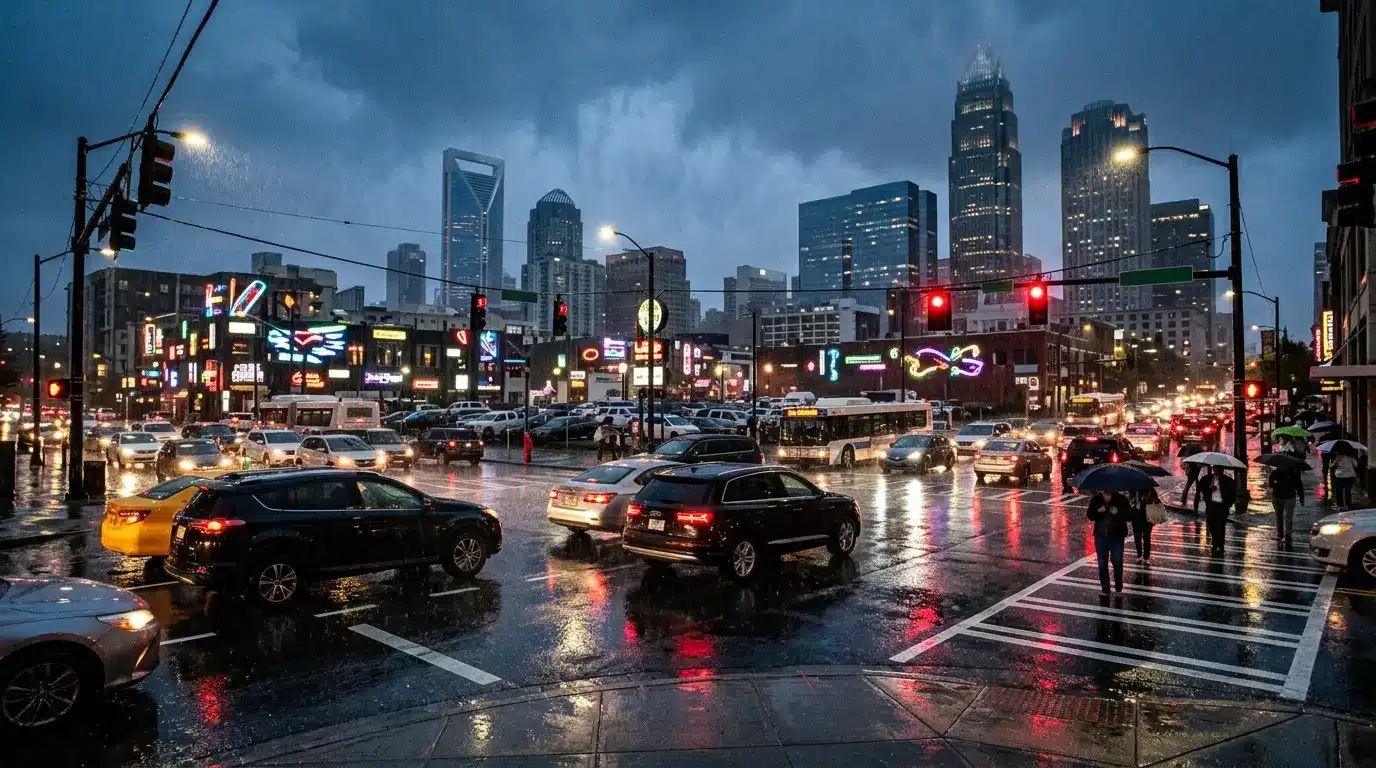
It is also worth mentioning that the conditions make the process even more complicated, including glare from the sun, rain, and fog, crest and curve shortening the sight, or something on the roadside like a tree.
Hard to See Is Not the Same as Not Responsible
Every driver has a legal obligation, under North Carolina law, to maintain a proper lookout, not only for large vehicles but also for everybody on the road. Driver negligence is measured against the standard of what a reasonably careful driver in similar or identical circumstances should have seen.
“Inattentional blindness” is not a driver’s excuse to be inattentive to other road users; it’s just a term that explains why passive driving or just looking at one point while driving is not enough. Since motorcycles are more difficult to see, drivers should actively look out for them.
How These Claims Are Evaluated Under North Carolina Law
A common form of motorcycle injury lawsuit is the one based on something called ordinary negligence, which is defined as the duty of care, not performing the duty of care specified, and resulting harm. The fact that North Carolina is known for the fault rule is important here as it operates on the principle of pure contributory negligence, meaning that if the victim is found to be at least 1% at fault, they will be barred from obtaining any compensation or reimbursement.
This places a heavy burden on the presented evidence, because if the insurance company can even present arguments that the motorcycle rider violated speed limits or did not have a well-placed position, the claim will be denied, even if the driver has not performed his duty of care.
Evidence That Shows What the Driver Could Have Seen
Determining who is at fault in a case usually has nothing to do with the driver’s statement of what they have seen, but rather on what evidence research finds as to what someone actually could have seen.
- Pictures of the scene that give an understanding of sight lines and obstructions.
- Video record from the surveillance system of the adjacent businesses and from the driver’s dash camera.
- Information from the event data recorder provides data about speed, braking, and steering.
- Information on the accident reconstruction process that allows for pinpointing the movement of both vehicles in detail.
- Motorcycle visibility analysis that shows when the rider came into the driver’s field of vision.
Myth vs. Fact
When drivers run into motorcyclists, their initial justifications rarely survive detailed scrutiny. Let’s separate common negligent driver misconceptions from what evidence actually reveals.
| Myth | Fact |
| “I didn’t see it” is a defense. | It is often an admission that the driver failed to keep a proper lookout. |
| High-visibility gear prevents these crashes. | It helps, but it cannot fix a driver filtering out motorcycles entirely. |
| Riders who get hit were probably speeding. | Most trace to another driver’s right-of-way error. |
| Loud pipes solve the problem. | Sound projects rearward; it does little for a driver ahead of you. |
Reducing the Risk on Both Sides
It is essential for riders to be noticed early and have an escape route:
- Pick a place that you are visible from to the driver through their mirror, and never just next to them.
- If you are near any vehicle that is about to turn, keep your foot on the brake and check its front wheel.
- Assume all the time that a driver has not seen you until they have done something to confirm.
For drivers, the change should be proactive:
- Look twice when you are at an intersection; pay attention to motorcycles.
- Make sure to turn your head, as mirrors create a huge blind area, according to NHTSA.
- Keep a safe distance, as motorcycles stop quickly.
The Reality of Motorcycle Claims
Science backs up one thing when asking how do cars not see motorcycles: bikes are more difficult to notice. Yet, this brain-based reality is an explanation, it’s not a reason. By law, motorists have to look for bikers themselves. If a driver fails to keep a reasonable lookout, he or she is held responsible.
In the event that a driver hits you and claims that “you came out of nowhere”, the case comes down to proving with evidence what was visible and when. With Tatum & Atkinson, the use of physical evidence coupled with crash analysis is how we make sure that negligent drivers will be held liable.
To talk to a local North Carolina motorcycle accident attorney, call us at (800) 529-0804 to receive free initial consultation.
FAQs: How Do Cars Not See Motorcycles in North Carolina?
Why do drivers so often say they never saw the motorcycle?
Even though physically, their eyes were able to register it neurologically, their brain was completely unresponsive. Scientists can explain the gap in perception, but legally, drivers are held responsible no matter what. The driver is not relieved of liability just because he did not see the hazard; rather, he is responsible for what any ordinary, careful driver should have seen.
Does bright clothing actually prevent these crashes?
It helps, but only slightly, and is not a complete solution. The use of high-visibility gear makes you stand out to a driver who is already watching you, but it can’t overcome complete inattention. Wear bright-colored clothes, be strategic while switching lanes, and still don’t think you can be seen clearly.
Can weather or lighting affect who is at fault?
Low visibility conditions, such as fog, heavy rain, or glare, mean the driver needs to be more cautious instead of less. Adverse weather does enhance the driver’s obligation to legally reduce speed and stay alert. These conditions, instead of shielding the driver, help establish what the driver should have done.
How is visibility actually evaluated after a crash?
It is by scientific reconstruction, not by personal testimonies, that investigators can prove a case. They use scene sight lines, sun position, road alignment, videos, and vehicle data as tools in the investigation. Through such reconstruction, it is possible to tell the exact moment when the motorcycle was visible and how many seconds the vehicle occupant had to dodge the motorcycle collision.
Can a surveillance camera really settle a fault?
The answer is often yes. Cameras are everywhere around intersections: gasoline stations, shops, traffic cameras, doorbells, and dashboards. Footage of the seconds right before every crash can help determine who has done something wrong without any argument. Still, the problem is that the time is limited, as footage can be overwritten within days, and companies are not obliged to keep anything unless they are asked.
What happens if both the driver and the rider make mistakes?
In North Carolina, this is a major concern, as this state does not apply proportional distribution of fault. According to the rule of pure contributory negligence, a biker who is even 1% at fault for the motorcycle accident North Carolina will be barred from receiving any compensation. This allows insurers to find at least a few errors that the biker may have committed to put the blame on them.
What should I do if a driver hits me and claims they never saw me?
Seek medical assistance immediately and secure the location of the incident. Take pictures of the junction from the perspective of the driver and yourself. Look for people who might have seen the event and take note of the direction of the sun. If there are stores close by with cameras, ask to obtain their recordings within the following days, and avoid making assumptions about your speed when talking to the insurance agency.
