Understanding Rear-End Accidents in North Carolina
Key Highlights:
- When understanding rear-end accidents in North Carolina, we need to know that they are the most frequent type of accident in the U.S.
- Usually, but not always, the rear driver is to blame in a rear-end collision, but not automatically (i.e., the driver was following too close).
- In North Carolina, a claim can be denied for even a 1% contribution to fault.
- Whiplash and other injuries can manifest from hours to days after an accident has happened.
- Evidence from dashboards or vehicle-stored computer data can determine whether a claim is disputed.
While it seems simple enough to be rear-ended by someone who wasn’t paying attention and ran into you, numerous nuances exist with respect to rear-end collisions because North Carolina has some of the strictest fault rules in the country. We at Tatum & Atkinson Law Firm have worked with hundreds of clients dealing with rear-end collisions since 2006.
In order to know your rights after an accident where you were rear-ended, it is important to gain an understanding rear-end accidents in North Carolina, who carries the legal responsibility for the accident, what are the most common types of injuries suffered as a result of these accidents, and what your legal options are under North Carolina law.
Don’t handle complicated insurance rules alone. Contact our skilled North Carolina car accident lawyer at (800) 529-0804 today for a free consultation.
Understanding Rear-End Accidents in North Carolina and Why They’re So Common
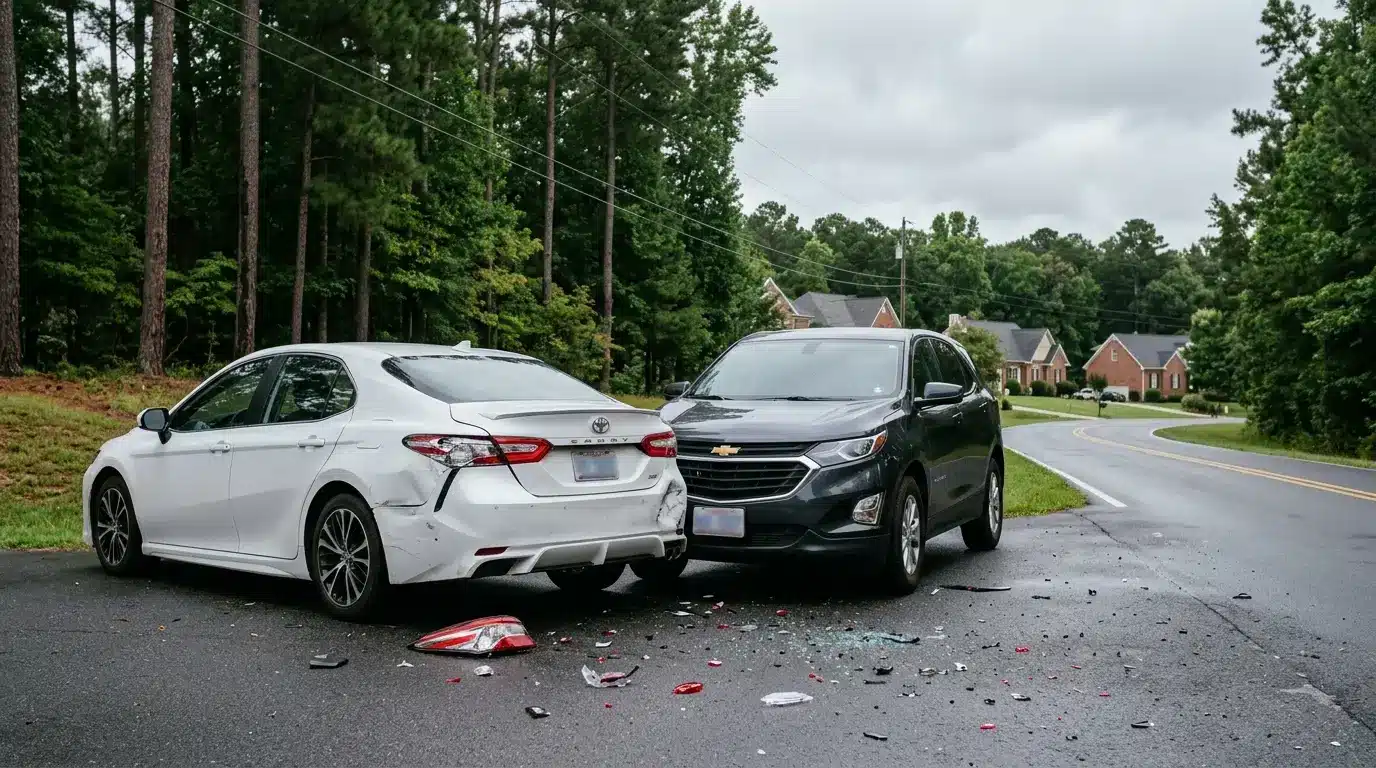
A rear-end collision occurs when one vehicle collides with the rear of another vehicle. According to NHTSA, rear-end collisions are the most common type of collision, making up roughly 29 percent of all collisions, more than any other type of vehicle accident.
They usually occur in areas with a lot of stopping and starting due to merges and stop-and-go traffic on highways like I-40 and the I-440 Beltline, as well as traffic lights and stop signs on connecting Raleigh roads. The speed of a vehicle on a highway will increase the severity of a minor accident if an accident does occur.
Common Causes of Rear-End Collision North Carolina
Here are some common reasons why rear-end collisions happen in North Carolina.
Distracted Driving
Drivers lose focus on the road when they are distracted by texting, searching for directions, eating, or reaching for objects. This is one of the primary reasons why drivers fail to notice the slowing of traffic ahead of them in time. Distraction is also cited by the National Highway Traffic Safety Administration as one of the top contributors to rear-end crashes.
Tailgating and Following Too Closely
North Carolina law (N.C.G.S. § 20-152) prohibits drivers from tailgating or failing to maintain a reasonable and prudent distance between their vehicle and the vehicle in front of them. When a driver is too close to another vehicle, that driver has no time to react when that vehicle suddenly stops, resulting in a tailgating accident.
Speeding and Sudden Stops
The greater the speed of the vehicle at the time of the crash, the longer it will take to stop and the harder it will hit another vehicle. If a speeding vehicle comes upon an unexpected stop (for example, a traffic light, turn, or animal in the roadway), a rear-end collision will occur.
Weather and Road Conditions
Bad Weather such as rain, fog, ice, and wet leaves, will increase stopping distances and reduce visibility. Drivers who do not slow down during summer thunderstorms and winter ice in North Carolina cannot stop in time.
Mechanical Failures
Worn brakes, bald tires, and burned-out brake lights often result in rear-end collisions. A driver who has brake lights that are not functioning is not warning the vehicle behind them that they are stopping and creating the very accident the law is attempting to prevent.
Injuries Commonly Caused By Rear-End Crashes
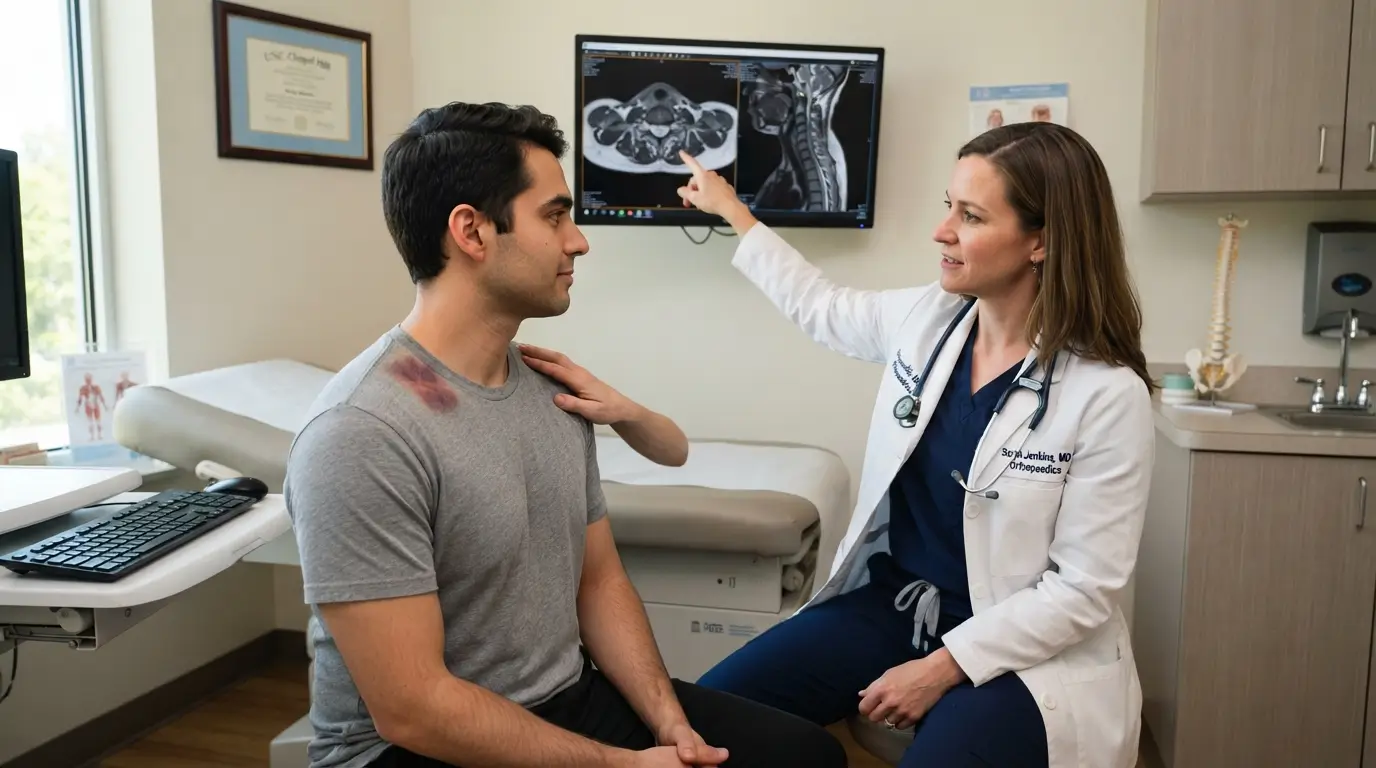
A rear-end collision at a relatively low speed can cause injury, and the important thing to remember is that there are often symptoms that appear after a delay (for example, sometimes it takes hours or sometimes days).
Whiplash and Neck Injuries
Whiplash (back and forth motion of the head) can strain the neck’s muscles and ligaments, which is reported by the American Academy of Orthopaedic Surgeons as being common following a rear-end crash. Symptoms do not typically appear until one or two days after sustaining this type of injury.
Back and Spinal Injuries
The same force causing a rear-end collision can also cause permanent tissue damage, including herniation of discs and soft tissue damage to the back through strain and excessive movement. These injuries can linger for years and may require surgical intervention in the long-term.
Head and Brain Injuries
A head that is suddenly propelled forward or strikes against an object (e.g., steering wheel, dashboard or window) may sustain a concussion or traumatic brain injury despite no external signs of an injury being visible.
Fractures and Soft-Tissue Injuries
Those who brace themselves against a dashboard or steering wheel may suffer from wrist and arm fractures. The sudden impact may also cause bruises, sprains, and other soft tissue injuries.
Who’s at Fault in a North Carolina Rear-End Crash?
North Carolina is an at-fault state, so the driver responsible for the accident will pay damages to anyone who suffered injuries or property damage from that accident.
Why the Rear Driver Is Usually Liable
A responsible driver leaves sufficient distance to stop their vehicle. Rear-end collisions are typically the result of being too close to the vehicle in front of them or not paying enough attention while driving. By this logic, the driver who hits the back of another car has failed to take due care, thus they would be liable.
When the Front Driver Shares the Blame
Front drivers can also share liability in a distracted driving rear-end collision. If the front driver brake checks, suddenly stops for no apparent reason, has inoperable brake lights, cuts in front and jams on their brakes, or backs up, causing the rear driver to hit them, the front driver will be deemed to share liability in the accident. Additionally, if the front driver is distracted or impaired and causes the rear driver to hit them, it will also result in them sharing liability with the rear driver.
The 1% Rule: Why Shared Fault Is So Dangerous Here
North Carolina adheres to pure contributory negligence. Because of this, if you are determined to be even just 1% responsible for your accident, you will not be able to recover anything from the other party at fault. Thus, the entire strategy for the other side will usually be to establish a tiny degree of fault against you. Therefore, collecting evidence establishing your innocence from all blame is critical.
Chain-Reaction Crashes
Chain-reaction type accidents create complicated situations in determining how many impacts took place and who impacted whom first. In chain-reaction type accidents, several drivers may share some degree of rear-end crash fault NC depending on several variable factors such as how close they were following behind another vehicle and how quickly (and safely) they reacted. Determining the sequence of impacts is critical in establishing a right to recover for damages.
Proving Your Rear-End Claim
Achieving a successful recovery of damages that arise out of a rear-end collision primarily depends on the collection of objective evidence, proper documentation of injuries in a timely manner, and avoidance of the typical traps commonly used by insurance adjusters for denying claims.
Evidence That Decides Liability
The most effective evidence will be objective, i.e., dash camera video, police crash report, photographs of the damage and scene, eyewitness statements, the damage pattern on both vehicles, and electronic data stored in the vehicles.
Why Prompt Medical Care Matters
Whiplash injuries often do not present symptoms until days or weeks later; therefore, you should always consult with a physician as soon as possible after an accident, at least the same day as the collision. A record of your injury on the same day as the accident will show an insurance company that the injury was caused by the crash, rather than being used against you by showing that there is a gap in treatment.
Mistakes to Avoid After a Rear-End Crash
There are several major mistakes an individual can make following a rear-end collision that will jeopardize their claim:
- Apologizing or admitting fault at the accident scene
- Providing recorded statement(s) to the other insurance company
- Not receiving medical treatment right after the accident
- Posting anything about the accident on social media
- Accepting the defendant’s insurance company’s first offer.
Insurance, Compensation, and Claim Value
The process of filing an insurance claim involves knowing how to get total compensation, the elements that contribute to the monetary worth of your case, and how to ensure that your claim is not affected by the investigation done by the adjusters.
How the Insurance Claim Works
Typically, you will file your insurance claim through the at-fault driver’s liability insurance. If the at-fault driver was either uninsured or underinsured, your uninsured or underinsured motorist coverage may apply. During this process, the insurance adjuster is looking for the 1% they can use to deny your claim.
Compensation You May Recover
A claim can seek compensation for medical bills, lost income and reduced earning capacity, pain and suffering, and property damage. If a family member is deceased due to someone else’s negligence, they may also file a wrongful death claim against the at-fault party.
What Affects the Value of Your Claim
The value of your claim is determined by your injury’s severity and permanence, the amount of documentation provided regarding your injuries, the amount of wages lost, how clearly liability can be shown to point away from you, and the amount of insurance available to pay your claim.
How an Attorney Builds a Rear-End Case

Even a “clear” rear-end case could fall apart due to the other side pinning down a very small amount of fault on you. An attorney collects and stores dash camera and all vehicle data information before it is used, analyzes and spends time developing the accident report, witnesses’ statements, and reviews medical documents to link the injuries to the accident, and negotiates with the adjuster so the client doesn’t say anything that could affect their recovery.
Based on our experience at Tatum & Atkinson, the cases that settle favorably are those in which fault is determined early, and there is never an opportunity for a 1% argument to start. We, the Heavy Hitters, are aware of what tactics are used by the other side, and we know how to tackle them.
Got Rear-Ended in North Carolina? Consult With Our Experienced Lawyers at Tatum & Atkinson
When you are in a rear-end car accident in North Carolina, it can be incredibly confusing if the insurance company tries to say you were at fault. In North Carolina, if you are deemed to be even one percent at fault, you could lose your entire claim; so understanding rear-end accidents in North Carolina and getting legal help early is critical.
Since 2006, the attorneys at Tatum & Atkinson have been helping injured North Carolinians through our office in Raleigh and throughout North Carolina. The Tatum & Atkinson Heavy Hitters move quickly to gather evidence to prove the other driver was 100 percent at fault, and work on a contingency basis so that if you do not win, you do not pay.
Don’t let the insurance company deny your claim. Call Tatum & Atkinson toll-free at (800) 529-0804 for a free consultation today.
Frequently Asked Questions
I was rear-ended but the insurer says I was partly to blame. Can I still recover?
Your claim may be barred with only 1% fault, so insurance companies will search for a reason to place the blame on you. Don’t accept the other party’s view of the facts; there is usually objective proof available, and a lawyer can help gather this proof and challenge the other side’s theory.
How long do I have to file a rear-end accident claim in NC?
Three years after the accident occurs, a wrongful death claim falls under a statute of limitations of two years. Delaying filing your injury or wrongful death claim can hurt your case because dashcam footage and vehicle data can be deleted within weeks following the accident.
What does it cost to hire a lawyer for a rear-end crash?
There will be no fees to you unless your case is successful and you recover; there will also be no cost to you for an initial consultation. The firm will also advance all costs related to building your claim.
My car barely has a scratch. Can I still have a real injury?
Correct. Soft tissue injuries and whiplash can also be sustained in low-speed accidents. It may take hours or days for symptoms to develop. Contact your doctor as soon as possible. An early medical record creates protection for both your health and your whiplash injury claim.
Will my rear-end case go to trial?
While a majority of cases settle due to clear liability, an insurer that denies fair compensation because of the 1% argument will typically be willing to change their initial offer if you try the case instead of settling.
