What Is An ATV Accident In North Carolina?
Key Highlights:
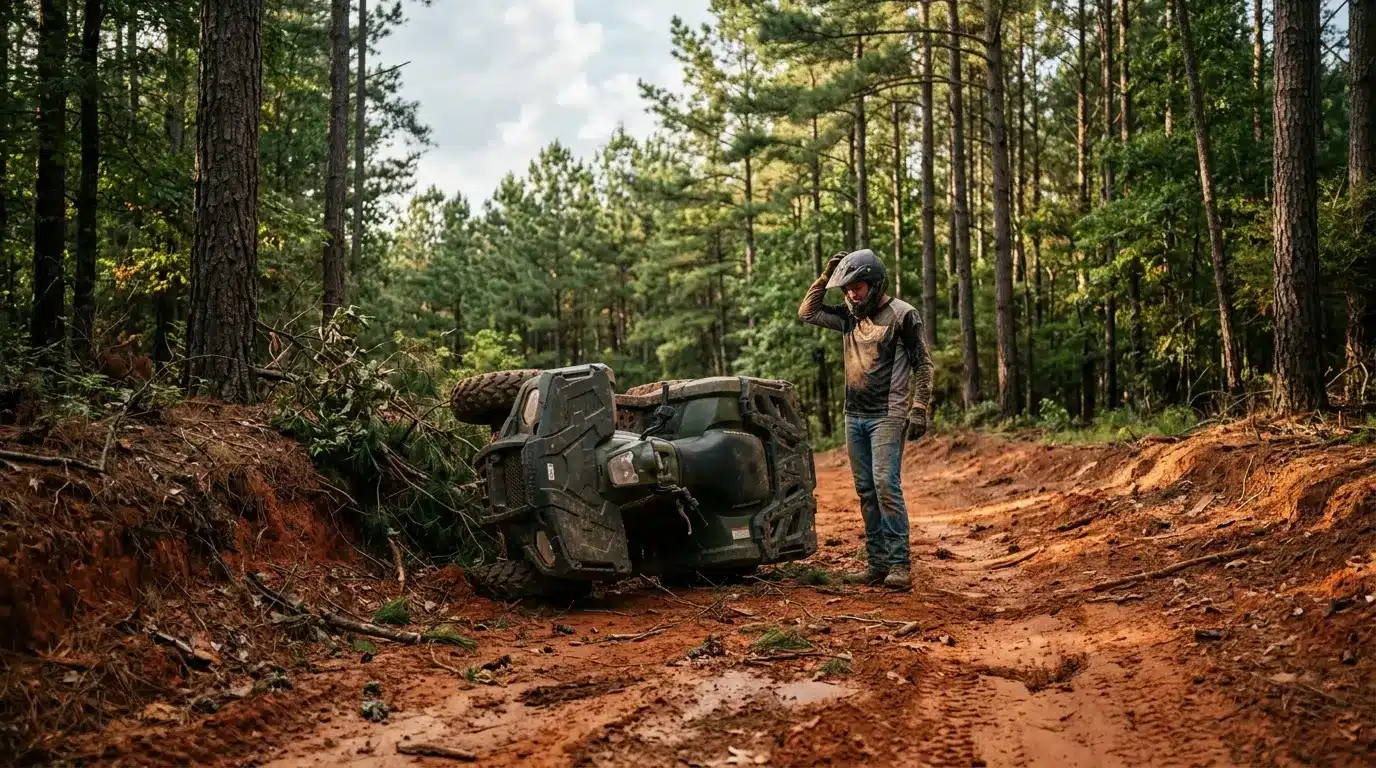
- What Is An ATV Accident In North Carolina? Any type of accident, such as rollovers and collisions, that occurs with an ATV at a location that is considered “off-road” will be classified as an ATV accident.
- Some factors contributing to ATV accident in North Carolina may include speed, traveling over rough terrain, riding with passengers, inexperienced riders, unsafe turns, not wearing helmets, riding on paved roads, or having equipment problems.
- ATV rollover accident North Carolina may result in serious injuries, including but not limited to: head injuries, broken bones, spinal cord injuries, crush injuries, organ injuries, and death.
- ATV accidents involving children are particularly serious because children do not usually possess the required physical size/strength or mental capacity/decision-making ability to avoid them.
- ATV injury claims North Carolina can result from negligent riders, inadequate supervision, unsafe conditions on property where ATVs were used, and defective equipment. In addition, some ATV claims can arise from commercial rental companies and/or issues with insurance companies.
What exactly does that mean? If you are asking what is an ATV accident In North Carolina, then the direct answer would be that your injury occurred as a result of being involved in some sort of ATV-related accident somewhere within the state of North Carolina.
The scope of an ATV accident includes the following:
- where they occur (farm, trail riding area, trail hunting grounds, private lands, public campgrounds/outdoor recreation areas) and
- types of crashes (rollovers, ejections) as well as
- various other contributing factors (such as a parent riding with their child, number of passengers, children riding with an adult, riding up a steep hill, mud, gravel, and speed).
Due to the open body design and high center of gravity of ATVs, as well as the fact that they are intended to be used in both novice, i.e., recreational, settings and experienced (advanced level), users/operators will experience that fun ride an ATV can become serious very quickly after beginning to ride an ATV.
My name is Robert Tatum, with Tatum & Atkinson Law Firm, a veteran-owned firm, & since 2005, our firm has had over 65 years of combined experience representing injured victims in North Carolina’s legal community. We will provide you with the best representation possible.
What Counts As An ATV In North Carolina?
The North Carolina General Statutes define an all-terrain vehicle as a motor vehicle with a width of less than fifty inches that has a minimum of three low-pressure tires and is manufactured for off-highway usage. The classification does not include golf carts, utility vehicles, or lawn mowers. The state definition can be found in General Statutes 20-4.01.
When it comes to an all-terrain vehicle accident NC, that means it is related to a crash involving an off-road vehicle, specifically not a car, motorcycle, or lawn mower.
Why the legal definition matters
This legal definition is important because if you get into an accident with an all-terrain vehicle, the rules governing the ATV and the expectations of safety will likely be different from those if you were involved in a car accident.
The insurance questions, as well as the claims for injuries that are received, will vary from those that may arise out of an automobile accident. Additionally, accidents on private property can create significant legal and medical issues.
Where Do ATV Accidents Happen In North Carolina?
ATVs are often used in the more rural areas of farms, hunting land, mountains, woods, beaches, and private land for recreational purposes. These areas appeal to riders because they provide wide open spaces to travel, and there is lots of mud, hills, and freedom.
However, the same areas that appeal to riders also create a higher risk of accidents than other areas.
Sometimes, when someone gets into a recreational vehicle crash North Carolina, they may be far away from emergency assistance. If someone were to get into an ATV accident in a field, ditch, trail, creek, or woods, it could take longer for an ambulance to arrive than if they were riding in a city.
In the state of North Carolina, there are many places where people can ride ATVs other than in cities, which can make the possibility of an accident greater because of how quickly the terrain changes in the woods or mountains.
How weather and terrain add risk
There are also many risks associated with riding in those areas, such as the weather conditions and the terrain changing quickly. If there is wet clay, loose gravel, mud, leaves, or steep hills, the risks of an injury while riding an ATV can increase. If the weather is wet, then the surface could be slick, and a rider could lose control of their ATV very quickly. This difference in traction could cause a rider to experience a small accident, then that small accident to turn into large injuries.
What Usually Causes an ATV Crash North Carolina?
The ATV accident causes NC are a combination of speed, terrain, lack of experience, and the design of the vehicle. The rider can have a collision due to taking the turn too sharply, climbing a hill at too high a rate of speed, improperly braking on loose terrain, carrying a passenger on an ATV designed for single riders, or riding without a helmet.
According to the U.S. Consumer Product Safety Commission (CPSC), ATV riders should receive hands-on safety training, wear helmets and protective gear, refrain from riding on paved roads, refrain from consuming alcohol or drugs before or while riding, and never carry more than the number of passengers for which the ATV is designed. The CPSC provides other ATV safety information on its official website.
Why paved roads are risky
Paved roads pose unique hazards when riding an ATV. Many ATVs are designed for riding on dirt, grass, gravel, and uneven terrain, not for riding in a traffic lane or on solid pavement. As a result, tires and handling characteristics are dramatically different. Additionally, the potential for falling off your ATV while riding on a paved road versus on an unpaved road is greatly increased.
Why Are Rollovers So Dangerous?
ATVs can roll over and flip over quickly. ATV rollover accident North Carolina can occur within seconds. When they happen, they might pin the rider, crush limbs, or cause head and/or spinal injuries. The driver may be thrown from the vehicle or become trapped under it as a result of how and where the vehicle rolls over. Rollovers are usually the result of a tight turn, going up or down a hill, suddenly stopping, or going over uneven terrain (e.g., bumps, rocks).
ATVs are not toys. They can weigh between 500 and 1000 pounds, so when they flip, your body absorbs the majority of the impact.
Common Injury |
Why It Happens |
| Head injury | Ejection, impact, no helmet, rollover |
| Broken bones | Falls, crush force, impact with the ground |
| Spinal injury | Landing on the back, neck trauma, compression |
| Internal injury | Handlebar impact, crush injury, blunt force |
| Road rash or cuts | Sliding, debris, exposed skin |
| Death | Severe head, chest, neck, or crush trauma |
How protective gear helps
Protective gear (i.e., helmet, eyewear, gloves, boots, long pants, and long-sleeved shirt) will help reduce the severity of your injuries if you are thrown or slide across rough ground as a result of falling off the ATV or being involved in a rollover. However, protective gear alone will not make you immune to injury while riding. By wearing this protective gear, you’ll give your body the greatest chance of surviving an accident.
Why Are Youth ATV Accidents NC So Concerning?
Children face a higher risk because they may not have the strength, size, balance, or judgment to control an ATV. They may also panic during a turn, overcorrect, or copy older riders.
ATVs pose higher risks for younger riders due to their lack of physical capabilities compared to adults in terms of strength, size, balance, and judgment. Young riders also might experience panic when making a turn, overcorrecting their steering when going out of control, or watching older riders and attempting to ride as they do.
As a result, North Carolina has laws prohibiting parents and guardians from knowingly allowing children under eight years old to operate an ATV, limiting the operation of riders under 16 years old based on the child’s age according to the manufacturer’s age warning label, and requiring that certain conditions be met for adult supervision. More information regarding these laws can be found at G.S. 20-171.15.
The U.S. Consumer Product Safety Commission warns that children under 16 years old should only operate age-appropriate youth-model ATVs and should not operate adult-sized ATVs.
Why do passengers increase the risk?
Most ATVs are designed for only one operator. A passenger can shift their weight while riding, decreasing the operator’s level of control over the ATV. The increased chances for rollovers created by the addition of a passenger are why passenger injuries can also occur while riding for only a short distance on one’s own property.
What Medical Care May Be Needed After An ATV Accident?
Seeking medical attention is critical after a four wheeler accident NC if a person suffers from any of the following injuries due to head trauma, loss of consciousness, neck pain or injuries, back pain or injuries, chest pain or injuries, abdominal pain or injuries, deep lacerations, swelling, numbness or weakness, or difficulties with walking.
Emergency medical treatment for these injuries may include diagnostic imaging, cleansing of wounds, application of stitches, use of a splint, surgical intervention, evaluation of concussion, and follow-up with specialty physicians to control pain.
Why can symptoms appear later?
A rider may have received a rush of adrenaline right after a trauma and may feel “okay” but will begin to have headaches, experience stiffness in the shoulder, and be in discomfort from abdominal pain once the rush of adrenaline has worn off.
Delay in presenting to a physician after a trauma is not uncommon; however, this delay can be very hazardous.
What Long-Term Effects Can ATV Injuries Cause?
The off-road vehicle injuries NC can impact everything, including employment, education, transportation, recreation, and day-to-day activities. The outcome of a serious crash can be:
- brain injury symptoms
- chronic pain
- limp
- scarring
- a chronic disability
- nerve damage
- post-traumatic stress disorder, and
Many of them may require physical therapy or surgery, and will not have the ability to do the same type of work or participate in the same activities again.
So many people get injured because of ATV riding accidents North Carolina, and it is considered a “weekend accident,” but it isn’t. One moment on a trail could potentially change the way you live your life for months, and in extreme cases, possibly can’t go back to the way you lived before.
What Should You Do After An ATV Accident In North Carolina?
Your priority in an accident is your safety. Get out of danger, if you can, and call emergency services (911) for any serious injuries. Avoid moving anyone who may have sustained head, neck, or back injuries unless they are in immediate danger.
Useful next steps include
- Get medical attention for all involved immediately
- Report the accident (if necessary) to the authorities
- Take photos of the ATV and the scene
- Preserve damaged clothing/uniforms/helmets
- Identify any witnesses to the accident, and
- Keep all medical records of injuries (including paperwork related to the accident).
- Retain the following records:
- maintenance records (including rental agreements for rentals)
- insurance documentation for the ATV and rentals to the rider(s)
- landowners’ contact information
- Photographs of the ground upon which the accident occurred (for example, the type of terrain, the type of road, the type of ditch or trail, the type of hazard).
All of the previous records and other documents may assist in pursuing ATV injury claims in North Carolina by illustrating the events leading up to the accident, how the accident occurred, and who may be liable for your injury.
Why preserving the ATV matters
Preserve the ATV because it could provide valuable evidence of the accident; be careful not to repair, sell, or discard the ATV before the brakes, throttle, tires, steering, frame, and maintenance records are documented. This equipment can provide evidence of how your injury occurred.
When Can An ATV Accident Lead To A Legal Claim?
Negligence by someone could give rise to a legal claim if the negligent party caused or contributed to the cause of the crash. Several types of negligence could include another rider, improper supervision, unsafe conditions on property, a manufacturer defect with the ATV, failure to maintain the ATV in safe working condition, negligence by a rental company, or dangerous trail conditions.
Each case has its own insurance issues to consider. Homeowner’s insurance, automobile insurance policies, business liability insurance policies, farm insurance policies, rental agreements, product liability, etc., may be available for different cases involving ATVs.
In any ATV case, the crash scene provides key pieces of evidence. All factors must be considered: the terrain, the ATV itself, the rider of the ATV, the rider’s safety equipment, and the extent of supervision.
So, What Is An ATV Accident In North Carolina?
An ATV accident in NC is an incident where someone is injured while riding an off-road vehicle (ATV). There are many places that a person can have an injury doing so, including private property (land), trails, on farms, on rural roads, or while recreating on an ATV.
Most people feel free on their ATV. However, the possibility of things going wrong when you combine speed, terrain, inexperience, unsafe equipment, and people’s poor ability to supervise each other while riding ATVs can make going from feeling free to having an accident happen very fast.
If you sustain any injuries from an ATV accident, be sure to seek medical attention, record evidence at the injury scene, keep the ATV as a record of evidence, and educate yourself on your options before the evidence disappears.
Call Tatum & Atkinson Law Firm For ATV Accidents in North Carolina
Just like you would have received assistance from a friend or family member if a loved one were in an ATV accident in North Carolina and got injured, they can assist by understanding the different options available to you and protecting your claims through a professional legal team at Tatum & Atkinson Law Firm.
With your free consultation, our lawyers will discuss with you the options and benefits available to you without charging an attorney’s fee unless they can recover compensation for your injuries. To see how we can help you with your injury, please call (800) 529-0804.
FAQs: What Is An ATV Accident In North Carolina?
Are ATV accidents more common on private or public land in North Carolina?
There are possibilities of accidents on private land, farms, trails, rural property, and recreational areas when riding an ATV.
Do helmets significantly reduce injuries in ATV crashes?
The use of helmets while riding an ATV can also help reduce the chance of brain injury from a crash and brain trauma as a result of the rollover of the ATV, being ejected, or coming into contact with other objects.
Can passengers get injured in ATV accidents?
Riders can be thrown, crushed, or injured by rollovers when riding an ATV that is designed for one rider; this includes passengers who ride an ATV that was designed for a single rider.
Are ATV accidents usually caused by mechanical failure?
ATV accidents are rarely limited to high-speed, rough terrain, inexperienced riders, sharp turns, and the quality of supervision. That being said, defects and maintenance may have an effect on the accident as well.
Can children legally ride ATVs in North Carolina?
There are restrictions on children under 8 years of age (including those classified as “children”), as well as on some riders under the age of 16, based on the manufacturer’s labeling requirements.
