What Should I Do If I Was In A Hit And Run Accident In North Carolina?
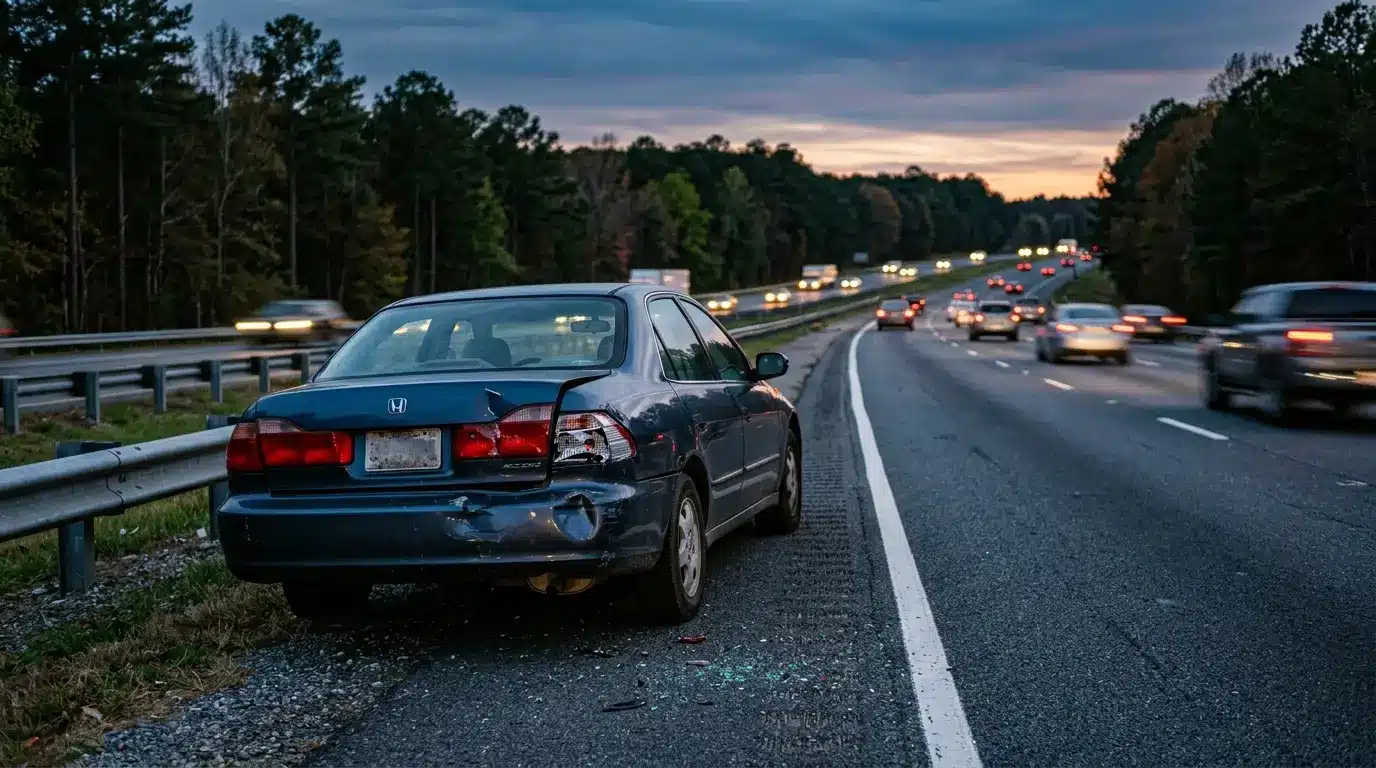
Key Highlights:
- What should I do if I was in a hit and run accident in North Carolina? In NC, leaving the scene of an accident with injury is considered a class H felony.
- Your uninsured motorist (UM) coverage can provide coverage even if the other driver is not identified or caught.
- To qualify for your UM claim through NC law, you will usually have had to have touched the other vehicle during the accident.
- You should report the accident to law enforcement immediately; delays may affect your ability to collect your UM benefits.
- UM limits increased to a minimum of 50/100/50 in July 2025, so you should monitor this when selecting insurance coverages.
- Your insurance company can litigate against your UM claim just as with any other claim, making it imperative to provide compelling documentation and proof of your claim.
Being involved in a hit-and-run accident North Carolina is one of the most unpleasant experiences. You may feel disoriented and shaken when you sustain an injury, and you will also be required to pay for the damages caused by the accident.
After being involved in a hit and run, you are probably asking yourself, ‘What should I do if I was in a hit and run accident in North Carolina?’ If this is the case, then you may be entitled to compensation for your losses even if the driver responsible for the accident cannot be located. Here is a quick guide by Tatum & Atkinson Law Firm, providing some insight on how to handle hit-and-run cases, as well as how these difficult cases are investigated and how to make sure your insurance claim is valid.
Don’t handle a hit-and-run claim alone. Contact our skilled North Carolina hit and run accident attorneys at (800) 529-0804 today for a free consultation.
What Counts as a Hit-and-Run in North Carolina?
Under N.C.G.S. § 20-166, a driver involved in any North Carolina car accident must first stop at the scene; provide their name and other information; and, if there are injured persons, provide reasonable assistance. If the driver drives off the scene of the crash, it will be considered a hit and run.
Felony vs. Misdemeanor
If the driver leaves the scene of the crash, whether it is a felony or misdemeanor will depend on how much harm they caused; however, you can still pursue damages regardless of whether the driver committed a felony or misdemeanor offense.
It Still Counts If They Pause, Then Flee
A driver who slows down or stops momentarily and then flees without exchanging information has committed a hit and run. Also, if a driver strikes your parked car in a parking lot and drives off without leaving a note, this is also considered a hit and run.
What Should I Do If I Was In A Hit And Run Accident In North Carolina?
Here is what to do after a hit-and-run accident:
-
Get Safe and Check for Injuries
If you can safely get out of heavy traffic, call 911 if anyone is hurt. Never follow the car that has left the scene, as this may endanger you, and it is the duty of law enforcement, not you.
-
Call the Police and Get a Report
In North Carolina, you must report any motor vehicle crash involving injury or substantial property damage, including a hit-and-run. Report your crash as soon as possible, as the crash report is what supports your later insurance claim, and also, timely reporting can help protect your insurance coverage.
-
Capture the Fleeing Vehicle’s Details
Write down or record anything about the fleeing vehicle while it is fresh on your mind, such as the make, model, color of the vehicle, any part of the license plate, and the direction that the vehicle went. Even part of a license plate can help law enforcement identify vehicles.
-
Document the Scene
Take pictures of the damage to your car, any debris or paint transferred, tire skid marks, the location of the accident, and the time of day. Evidence of the damage to your vehicle can provide a visual representation of the physical collision that may be necessary for making your claim with an insurance company
-
See a Doctor Promptly
Some injuries do not show up or are not recognized until hours or days later, or they may go completely unrecognized. Getting to the doctor quickly not only protects you from potential health issues but also provides documentation that establishes the relationship between your injuries and the traffic accident.
How Police Investigate Hit-and-Run Cases
Authorities will search for witnesses, check any available surveillance or doorbell camera footage, find out if captured in-car videos exist, gather any paint or vehicle debris that may help identify the vehicle by make/model, and if there’s a partial license plate available, it can be checked against vehicle registration records.
You can increase the chances of the driver being located by providing as much information as possible to the authorities, including the color, type/size of the dent, and the direction of travel. Even if the driver is never located, a good investigative report with this evidence will help support your insurance claim.
Uninsured Motorist Coverage Is Your Key to Compensation
The principal component of nearly all North Carolina hit-and-run claims is the uninsured motorist coverage, as most hit-and-run drivers can never be located.
Why UM Coverage Applies
The law processes an unidentified driver in a hit-and-run as being uninsured; therefore, your own uninsured motorist coverage NC will cover your accident. North Carolina is one of the states where uninsured motorist coverage must be included in all auto policies, so you probably have the required UM coverage on your auto policy.
The Physical-Contact Rule
There are limitations regarding this rule: In the case of a hit-and-run UM claim, there must generally be actual physical contact between your vehicle and the vehicle involved in the accident. So if you swerve and hit something else, and did not actually make any contact with the phantom driver, your claim may be denied, which is another reason why documenting that contact is important.
New Coverage Limits in 2025
New coverage limits in North Carolina went into effect on July 1st of 2025. The drivers will now benefit from increased liability coverage limits of $50,000/individual, $100,000/accident, and $50,000/property damage. All drivers must also carry Underinsured Motorist (UIM) coverage. UIM coverage stacks over the liability limit and does not have a set-off. This means drivers now have more coverage than in previous years.
Your Own Insurer Becomes the Other Side
When UIM or UM claims are made, the claim is filed under the insured’s own insurance policy but handled by their own insurer. However, once the insurance company’s financial interests are involved, there is an adversarial relationship between the insurer and insured.
Insurers will then thoroughly investigate the facts regarding the cause of the accident and potentially dispute the severity of the insured’s injuries to reduce the amount the insurer has to pay out on that claim.
Challenges When the Driver Is Never Found
While the limits of your UM policy apply to UM claims, UM claims can be more complicated than they appear. Since there is no at-fault driver to blame, you will be required to provide the police crash report and physical evidence to prove that another driver was at fault.
The contact requirement can also be a significant hurdle. Your own insurer may also have the right to argue that you are partially at fault for the accident and, therefore, do not owe any damages based on North Carolina’s 1% theoretical contributory negligence laws.
Additionally, the amount of your recovery will be limited to the amount of your UM policy limit. Knowing what these hurdles are in advance will help you make the best decision on how to proceed with a claim.
Compensation and Common Mistakes
To increase your chances of recovering financially after being involved in a hit-and-run incident, it is important to know the kinds of damages you may be lawfully entitled to claim and also to refrain from making mistakes that might result in your being unable to take advantage of your uninsured motorist coverage.
What You May Recover
When you file a hit-and-run claim, you could be compensated for medical expenses (both past and future), lost income, emotional distress, and repairs to your vehicle (up to your uninsured motorist limits) as a result of the accident.
Mistakes That Weaken a Hit-and-Run Claim
Examples of the mistakes are failing to report the accident as soon as possible with the police, thinking that there is no driver involved therefore there cannot be a claim, making an oral statement to your insurance company before you know what your policy says, overlooking the contract requirements, not getting medical treatment, or accepting the first low ball offer your own insurance company has given to you.
How an Attorney Protects Your Rights
The basis of a claim for a hit-and-run depends upon evidence as well as the terms and conditions of your car insurance policy. Attorneys can help locate surveillance tapes before they are destroyed, work with law enforcement and other investigators to meet all aspects of the requirement to notify/contact, and represent you when your insurer undervalues a claim or tries to place responsibility on you.
In our experience, the critical factor in these matters is acting quickly, as video evidence and witnesses tend to disappear quickly. Heavy Hitter Attorneys understand how to hold insurers accountable for providing the coverage you purchased.
Hit by a Driver Who Fled The Scene Accident in North Carolina? Contact Our Car Accident Lawyers Now
It’s very frustrating to be abandoned following a collision. However, even if the person who struck you never appears, there are ways you can pursue recovery. If you’re asking yourself, “What should I do if I was in a hit and run accident in North Carolina?” the first thing you should do is secure legal assistance, so that evidence doesn’t go missing.
For more than 20 years, Tatum & Atkinson have represented injured people in all 100 counties of North Carolina from our office located in Raleigh. Our firm of Heavy Hitters understands complicated uninsured motorist rules, including the “physical contact trap,” and can help you compel your insurance company to provide you with all benefits owed. We charge a fee only if we deliver results for you.
Get the help you need after a hit-and-run. Call Tatum & Atkinson at (800) 529-0804 today for a free consultation.
Frequently Asked Questions!
What if the police never find the driver who hit me?
You can obtain compensation for your injuries since the unidentified driver is considered to be uninsured. You will need to file a claim under your own uninsured motorist coverage, as required by North Carolina law.
Does my insurance go up if I use my own UM coverage?
As a general rule, North Carolina does not permit an insurance company to charge an insured driver any points for an accident that was not their fault. Therefore, it is appropriate to use the uninsured motorist coverage that you purchased for this purpose.
The driver barely tapped me and drove off. Is it still worth a claim?
Most certainly. Even if you were only superficially injured or sustained no injury, you may not know your true injury status until much later after the fact. As long as actual contact occurred, you MAY have a claim under your uninsured (UM) benefits.
What does it cost to hire a hit-and-run lawyer?
You will have no upfront fees. All cases are handled on a contingency fee basis, where there is no charge unless you receive a recovery, and you will not owe anything for your initial consultation.
My insurer says I was partly at fault. Can I still recover?
It is possible that your own insurance company can use a 1% rule against you and deny your claim; however, if there is strong evidence and you have legal representation, it may be possible to overcome this type of defense.
Will my hit-and-run case go to trial?
Most damage claims are resolved through settlement, but if the carrier for your UM coverage refuses to settle fairly, it may be necessary to file a lawsuit and be prepared to take it to trial.
