Who Is At Fault In A Multi-Vehicle Pile Up In North Carolina?
Key Highlights:
- Who is at fault in a multi-vehicle pile up in North Carolina? It is often difficult to assign blame or liability. Depending on the circumstances, drivers could share liability after being responsible for a collision that created a chain of events, driving in a reckless manner, or simply not driving safely while conditions are poor.
- Because of the contributory negligence (1% fault) rule in North Carolina, any degree of fault bars you from recovering damages; even 1% fault can put you at a disadvantage.
- In many cases, private accident reconstruction specialists conduct independent analyses of accidents and may introduce evidence that the police report did not contain, which could change the way liability is determined.
- Insurance adjusters may attempt to obtain recorded statements from you or your medical records as quickly as possible before you have an opportunity to speak with a lawyer. This is a tactic used by insurance adjusters to limit their payout or deny your claim.
A multi-vehicle collision is one of the most chaotic and legally complicated types of vehicle collisions that occur on North Carolina highways. If there is a collision involving several vehicles (3, 5, or 10) all in one chain reaction, the question that everyone involved (adjusters, attorneys, and drivers who were injured) will ask is who is at fault in a multi-vehicle pile up in North Carolina? The answer to that question is usually not an easy one to arrive at, and if you do not clearly define who is responsible, you may not receive what you should be entitled to receive.
Our NC car accident lawyers at Tatum & Atkinson Law Firm have decades of experience representing victims of North Carolina collisions and assisting those victims in fighting for full and fair compensation for their injuries.
For further guidance or to receive your free case evaluation, get in touch with our car accident lawyers at (800) 529-0804 today.
Who Is At Fault In A Multi-Vehicle Pile Up In North Carolina
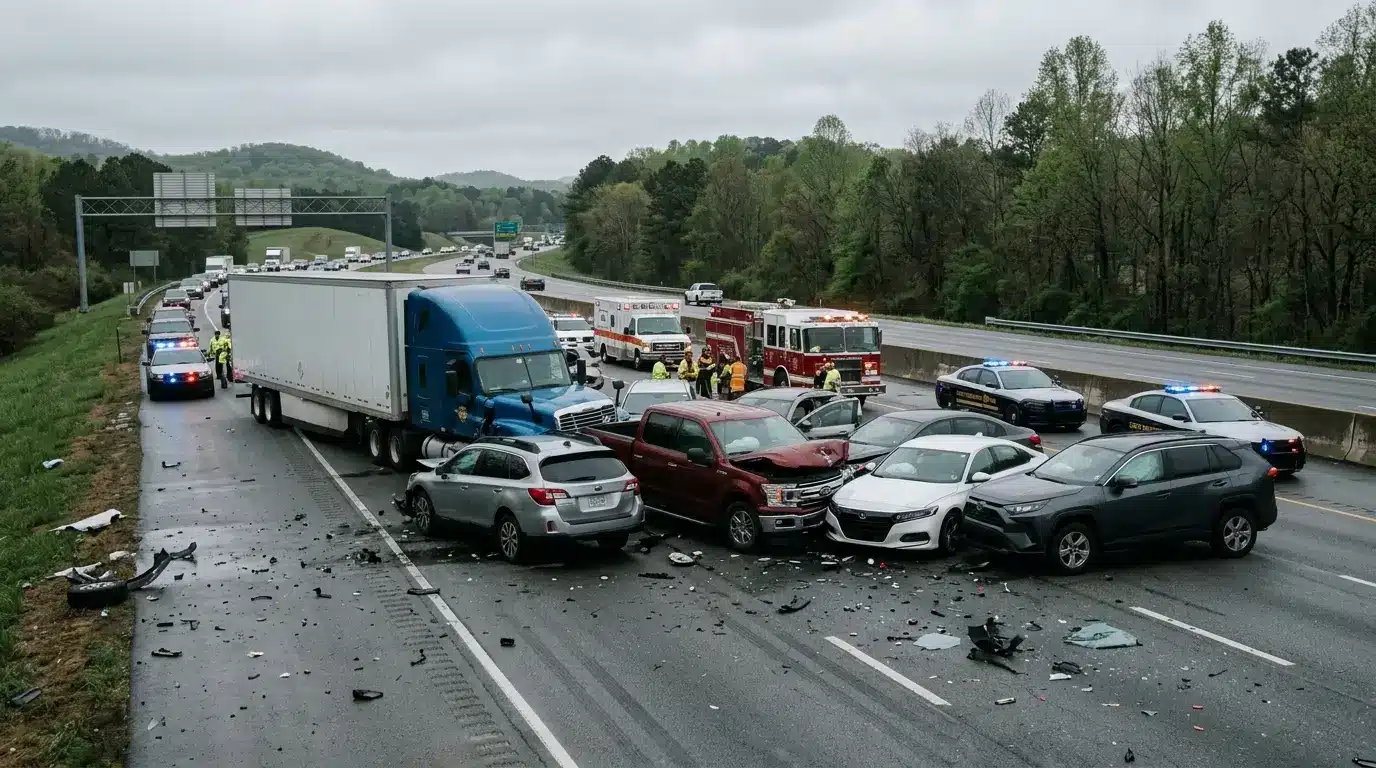
In North Carolina, a multi-vehicle pile up happens when a single incident occurs, causing three or more vehicles to collide with each other. Often, these car accidents result in a rear end chain collision North Carolina drivers dread, due to one driver suddenly braking on I-40 or I-85, causing the driver behind to crash into the vehicle in front of him, and ultimately resulting in additional collisions with other vehicles behind him.
Chain reaction accidents in North Carolina often start as a result of one or more of the following:
- A driver who is too close to the preceding vehicle at highway speeds
- A driver who brakes suddenly to avoid hitting a vehicle that has stalled or because of debris on the roadway
- Impaired or distracted drivers who are delayed in their responses
- Road conditions are wet, icy, or foggy, increasing the stopping distance significantly
Identifying the original caused event is only the first step towards determining fault in car pile up NC, however, it is not always the sole factor that matters legally.
Why Multi Car Crash Liability NC Is Rarely Straightforward
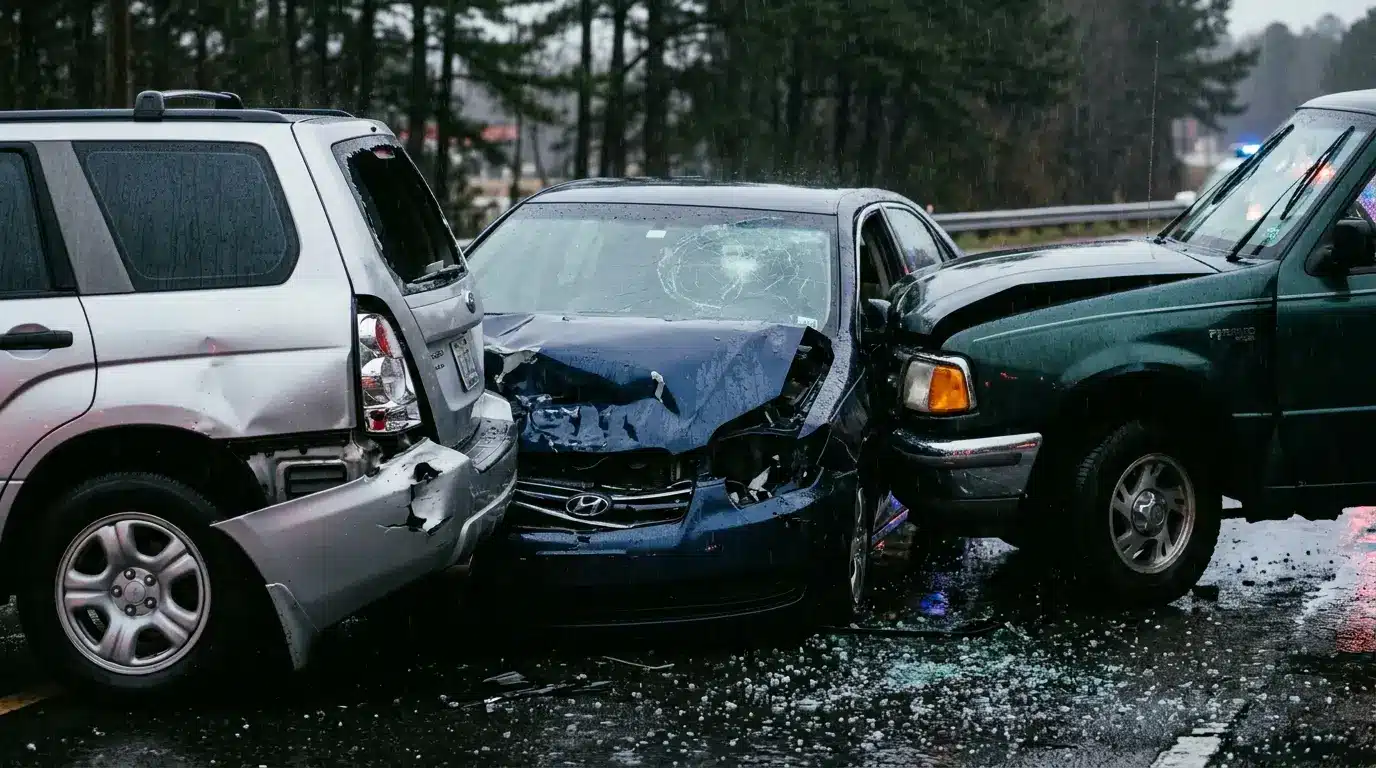
In North Carolina, an injured driver’s ability to collect damages is contingent upon whether they were at fault at all for the accident. Under the law of contributory negligence, if you are even partially at fault for the accident, you are prevented from recovering damages. This means that the process of determining fault in a pile up accident responsibility North Carolina will be crucial and is also a reason to have experienced legal representation available to assist you.
In a highway multi-vehicle accident in NC, any of the following drivers may be responsible for the accident:
- The driver who caused the initial contact.
- The driver in the middle who did not keep a safe following distance.
- The driver who changed lanes in a reckless manner before the collision.
- The trucking company that caused the obstruction.
- The government entity that was responsible for defective road conditions or signage.
Several parties may be liable to different degrees for the accident. Courts and insurance companies will evaluate each driver’s conduct separately.
How Police and Investigators Reconstruct a Multiple Vehicle Crash Investigation NC
In North Carolina, law enforcement officials respond to a multiple-vehicle collision (known as a “pile up accident in NC”) using crash reconstruction methods to recreate the accident scene by analyzing information such as skid marks, debris fields, and location of final positions of vehicles, traffic camera footage, dash camera footage, witness statements, and electronic data from the onboard event data recorders (EDR) also known as “black boxes.”
The final report issued by the police was to create a preliminary impression of who was at fault for the accident. However, this is not necessarily final; police reports may contain errors, omit relevant evidence, or state that they were unable to determine the cause of the crash. Frequently, accident reconstruction experts retained by attorneys to investigate the accident will find evidence that will alter who caused pile up accident NC. Because of this, the determination of fault for the accident may be in dispute long after the initial report is filed.
Key Evidence Used to Establish Liability in NC Multi-Car Accidents
Who is at fault in a multi-vehicle pile up in North Carolina is determined based on the facts collected through analysis. The evidence to use for establishing North Carolina traffic accident liability laws includes the following:
- Physical and digital evidence: Through measuring skid marks, vehicle damage, airbag deployment, and GPS from fleet trucks or ridesharing apps, it will be easier to determine speed, when brakes were applied, and where the cars were driving before the accident occurred.
- The role of weather and road conditions: Drivers can still be liable during inclement weather, fog, rain, ice, or low visibility. When driving at highway speed on a foggy day results in a highway multi vehicle accident NC, then this driver may have a high degree of fault, even if the weather “caused” the conditions to be dangerous. Courts will use the actions of each of the drivers to determine if they adjusted their driving accordingly.
- Speeding: Speeding is one of the largest contributing factors to serious multiple-vehicle pileup accidents. An individual who is speeding may be solely liable for causing the accident, even if they were not the first to brake.
- Witness and surveillance evidence: Significant witness statements and surveillance footage from traffic cameras and local businesses capture information missed by dashcams. Attorneys typically act quickly to secure witness and surveillance footage, as there is a chance that the evidence will be lost or destroyed before it is preserved.
The establishment of a complete picture of liability based on these sources is vital to supporting strong negotiations on insurance claims multi car accident North Carolina, and to providing necessary evidence for any resulting litigation.
How Insurance Claims Multi-Car Accident North Carolina Cases Are Handled
Insurance companies handle multi-vehicle accident claims, evaluate each driver’s policy separately, and carry out their own fault determination processes. With three, four, or more insurance carriers involved, each one has a financial interest in limiting its policyholder’s percentage of fault in the multi-vehicle pile up.
The Adjuster Strategy: Fast Action, High Stakes
The adjusters will immediately reach out to you regarding an accident. Their goal is to have you sign off on your injury so that they can limit what they will pay. To protect their bottom line, adjusters employ several strategies:
- Recorded Statements: They may ask you to provide a statement of how the accident occurred, hoping to find inconsistencies in your account.
- Medical Record Requests: They may request your medical history to prove that your injuries were not the result of the accident.
- Early Settlement Offers: They may offer you money now, before you know the full extent of your injuries.
The Danger of “Contributory Negligence”
The law of North Carolina uses a strict rule of contributory negligence. This means that an insurance company that proves that you contributed to a claim in any way, as little as 1% of the fault, can deny the insurance company’s obligation to pay you a single penny.
“Do not provide recorded statements to an insurance company unless you consult with an attorney first. One mistake regarding your account of what you saw, where you were looking, or how fast you were going can destroy your case.” – Robert Tatum
Why Legal Guidance Matters After a Chain Reaction Accident North Carolina Fault
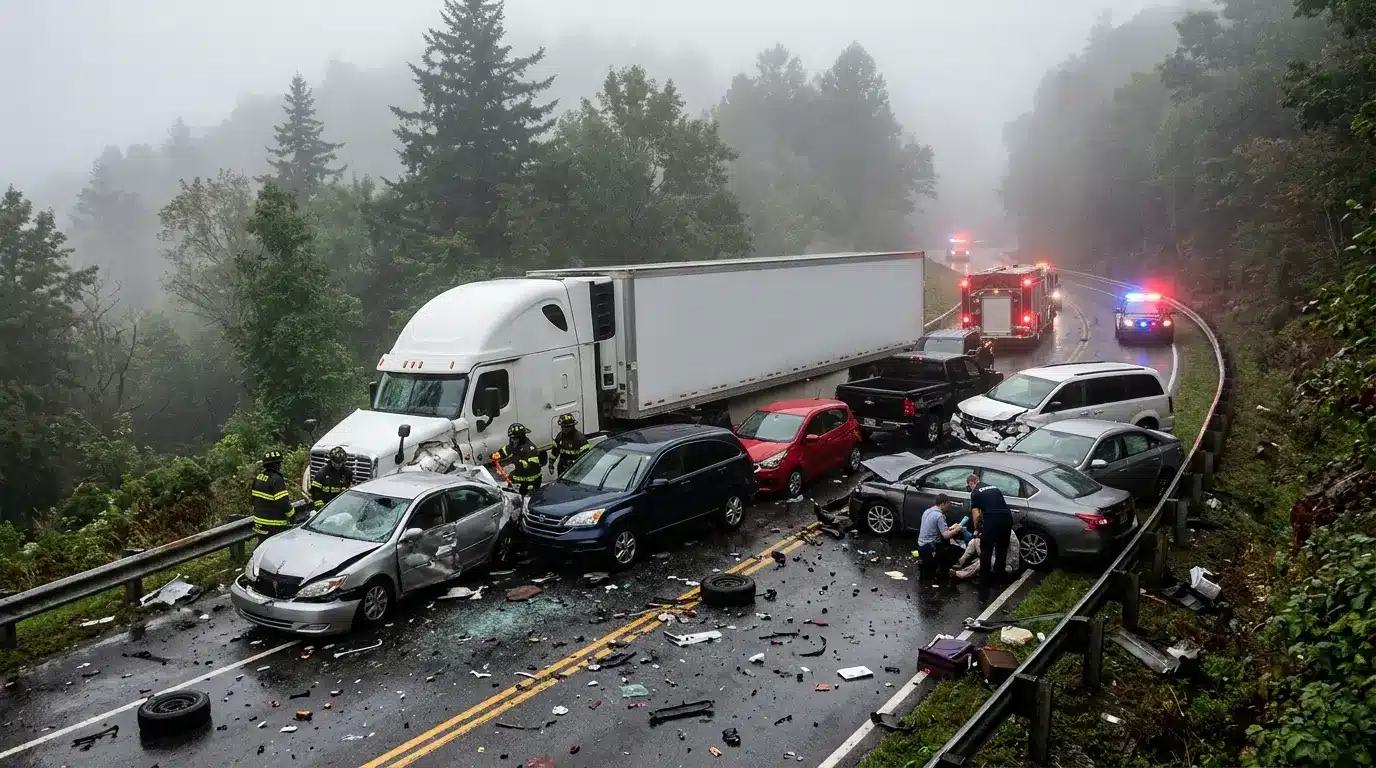
Identifying who is at fault in a multi-vehicle pile up in North Carolina is very difficult because of the large number of responsible parties, the strict contributory negligence rule, and disappearing evidence. The insurance company often uses aggressive tactics against the injured person, resulting in them receiving much less than they deserve or not being compensated at all.
Tatum & Atkinson Law Firm has a wealth of knowledge about North Carolina traffic accident liability laws and knows the best methods to fight back. We help with every aspect of your multi-car crash liability NC case, from preserving evidence to settling your case against the negligent party.
Injured in a pileup? Call Tatum & Atkinson Law Firm today at (800) 529-0804 for a free, no-obligation consultation we charge no fees unless we win your case.
Frequently Asked Questions About Multi-Vehicle Pile Up Fault North Carolina!
Is the first car always at fault in a pile-up accident?
Even if the lead driver causes the initial event, each driver’s actions will determine responsibility. For example, if the rear driver is tailgating, speeding, or driving while he/she is distracted, the other drivers may share a lot of the responsibility if these actions were contributing factors.
Can more than one driver be responsible for a multi-vehicle crash?
Yes, several drivers can be equally responsible for a collision because of their personal actions. North Carolina courts and insurance companies will treat each driver’s actions uniquely to determine how much that driver’s actions contributed to the accident.
How do weather conditions affect fault in a pile up?
Weather does create hazards; however, it neither absolves the driver of their responsibilities to adjust their speed and following distance for conditions like fog, rain, or ice. If they fail to operate their vehicle safely, they can be found to have acted negligently.
Do police always determine who caused a pile up accident?
No. Police crash reports are the initial expression of what the police think about an accident. Accident reconstruction and private investigation create detailed findings of how an accident happened and who is liable for it.
Can passengers injured in a pile up file claims?
Yes, if you’ve been injured as a passenger in an accident or a multi-car crash, you have the right to file a claim against the at-fault driver or multiple drivers. As a passenger, you are generally not deemed liable and, therefore, your chances of recovering your total damages are maximized.
