What If The Person Who Hit Me Was Driving For Work In Virginia?
Key Highlights:
- What if the person who hit me was driving for work in Virginia? You may have the right to obtain compensation under the employer’s insurance policy rather than just using that of the driver involved in the accident.
- In Virginia, an employer can be found responsible for a company vehicle accident caused by the employee in order to carry out work duties.
- If a driver is found to be an employee, then in most cases it is taken as a fact that the driver was doing his job unless proven otherwise by the employer.
- Ordinarily, employers are not liable for accidents caused by an independent contractor, which is a vital point for rideshare companies and other delivery services.
In Virginia, if you happen to be hit by someone driving for work in Virginia, you might be eligible to sue their employer, as well as the driver. In many situations, this means going after the employer’s higher insurance policy versus the driver’s smaller coverage. Our team of experienced Virginia car accident lawyers at Tatum & Atkinson Law Firm can help you; whether this possibility has a legal relevance depends on several questions of law.
Get in touch with Tatum & Atkinson Law Firm at (800) 529-0804 today for an assessment of your case free of charge.
When an Employer Is Responsible
According to the doctrine of respondeat superior, an employer will be liable for any negligence committed while the employee was completing tasks connected with work. Virginia law takes this principle one step further. Once you can prove that the driver was an employee, the law assumes that the person was acting in the course and scope of their employment, and it becomes the employer’s responsibility to prove otherwise (Legal Information Institute).
What is Being On the Job or Off Duty
To establish employer liability, a lawyer needs to know if the person was performing work for the employer (the company) or was acting on their own behalf (personal reasons).
A person is regarded as “on duty” if they are performing work-related tasks, such as making deliveries, visiting different work locations, or undertaking special errands requested by the employer.
In contrast, a person is deemed off duty during an ordinary commute from home to work, personal travel that has nothing to do with work, and when he/she goes out of their way to complete a trip to work.
Virginia Vicarious Liability: Employee vs. Independent Contractor Rules
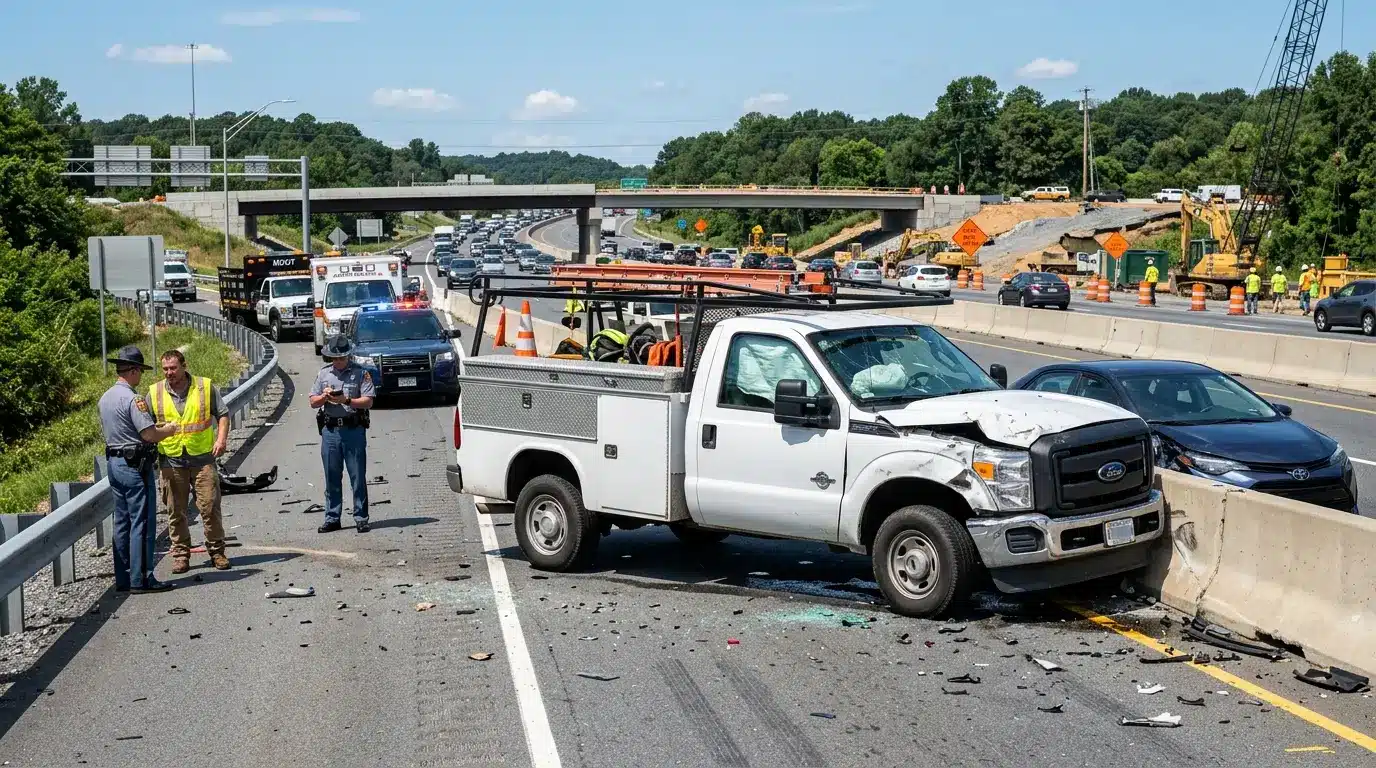
Employers in Virginia cannot be held liable for the actions of independent contractors, but they can be held liable for the actions of their employees.
Generally, drivers of apps like Uber and delivery drivers are independent contractors, which results in the companies in question not being liable for their actions.
Common Work-Driving Situations
The following may be included:
- Delivering goods and meals by means of delivery representatives.
- Sales and service individuals who are waiting between calls.
- Workers employed in construction and utility industries.
- Commercial vehicle operators are regulated by federal laws.
Proving the Driver Was Working, and the Insurance at Stake
It is required to provide evidence that the driver was on duty, such as payroll records, GPS logs, delivery documents, messages from the dispatch, records of the time, vehicle ownership, and testimonies.
An accident involving the driver may engage several policies: the driver’s personal policy, through which the insurance claim may be denied, the employer’s commercial insurance, and the rideshare policies.
The damages sought in the personal injury claim may include the costs of medical care, future treatment, lost income, reduced earning power, and damages for pain and suffering, among others.
Virginia’s 1% Rule and Common Mistakes
Virginia adheres to the harsh doctrine of pure contributory negligence, which means that any fault by a claimant, even one percent, results in the claim being rendered invalid.
Some mistakes include:
- Believing that the limited coverage of the driver’s personal insurance is sufficient
- Giving a recorded statement too soon
- Settling with one insurance company without knowing what commercial coverage is available from the employer.
There is also a two-year statute of limitations (Va. Code § 8.01-243), so you need to act fast, as important case evidence can vanish within that time frame.
Hit by Someone Driving for Work in Virginia? We Can Help
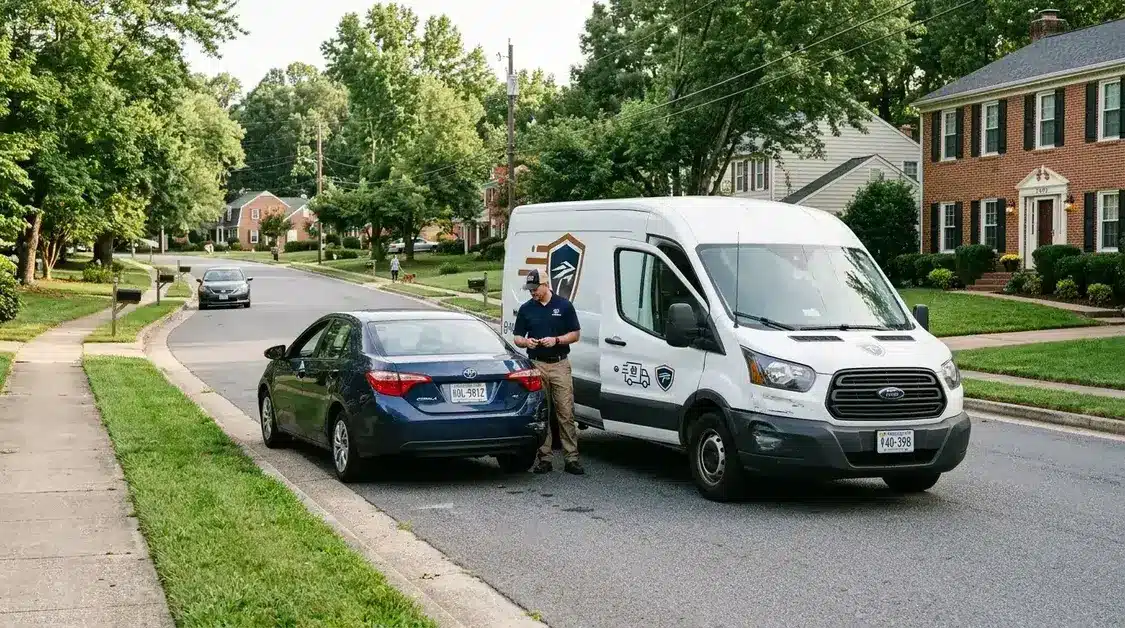
If you were involved in an accident, hit by someone driving for work in Virginia, then your accident claim is likely to involve proving employer liability in addition to the challenge of filing against one or more insurance companies. The first step in finding out who is at fault for your accident is to contact us so we can investigate the matter at no charge.
Tatum & Atkinson’s Heavy Hitters staff understands how to prove a crash from an employee was connected to the employer, and can work with several insurance companies to recover damages. The Virginia case will be handled by Jon Ward, who serves the southwest region of the state.
Contact us at (800) 529-0804 for a free consultation about your case. We only charge clients if we win.
FAQs: What If the Person Who Hit Me Was Driving for Work in Virginia?
Why choose to hold the employer responsible instead of just the driver?
Coverage. Most individual drivers carry only minimal limits, which are usually far below the amount needed to cover injuries sustained in a serious accident. Business firms generally have large commercial policies, and in case a business is responsible for the accident, its commercial insurance coverage will be applicable instead of coverage provided by an individual.
The driver was in their own personal car. Can the employer still be liable?
It is possible. Impacts of employer liability depend on what was occurring at the time, not whose name is on the registration. A pizza driver or salesperson who uses a company’s vehicle could still be seen as being in employment. The reason for the necessity of the proper analysis of work-related car accidents is that a personal insurance provider may refuse to cover any claims related to business usage.
What if the driver was an Uber, Lyft, or app delivery driver?
Usually, those drivers are self-employed, thus allowing the company to exonerate itself from liability. More decisive is the insurance of the platform and its nature, depending on whether the app was shut down, waiting, or on an active ride. A crucial early step is learning the status of the driver’s app at the time of the accident, for it determines the policy applying.
What if they were just commuting to work?
Adequate time spent commuting typically isn’t considered part of one’s wages or employment, so normally the employer wouldn’t have any liability. However, there are exceptions to the rule: special errands, on-the-clock travel, company vehicle usage, and being on call are only a few scenarios that can turn an average commute into a work-related activity.
What does it cost to look into an employer claim?
Legal cases are conducted on a no-win-no-fee basis, meaning there are no legal fees to be paid until the case is won. However, consulting with a lawyer as early as possible will allow collecting necessary information and prevent the loss of any data.
