What Is My Maximum Recovery In An Uninsured Motorist Claim In Virginia?

Key Highlights:
- Maximum recovery in an uninsured motorist claim in Virginia applies to situations where the at-fault driver has no insurance or cannot be identified.
- In a hit-and-run accident case, there is no need for the vehicles to have made physical contact.
- The amount of your insurance coverage is typically your maximum recovery limit.
- The insurer that provides your UM coverage Virginia is free to contest the claim.
- This is separate from an underinsured motorist claim, in which the at-fault party carried liability insurance but not sufficient coverage.
Regarding the maximum recovery in a Virginia uninsured motorist claim, the uninsured motorist claim Virginia portion of your own auto insurance is the coverage available if the other party who caused the accident did not have insurance or could not be identified as having insurance.
With no insurance or an uninsured driver responsible for your injury, the adversary turns out to be your very own insurance provider, and this is not something you can handle alone.
This is Robert Tatum of Tatum & Atkinson Law Firm. For almost 14 years now, since our firm was founded by veterans, we have gathered decades’ worth of experience in dealing with Virginia uninsured motorist claims and hit-and-run accidents. We are your Virginia car accident lawyers, and we know how to deal with uninsured motorist insurance in Virginia.
UM vs. UIM: Fixing Two Different Problems
UM vs. UIM, an underinsured (UIM) claim arises if the driver at fault for the accident carried liability insurance, but not enough to pay the damages incurred. An uninsured motorist claim (UM) uninsured motorist claim Virginia arises where there was no liability insurance to begin with.
The Following Cases Trigger a UM Claim in Virginia
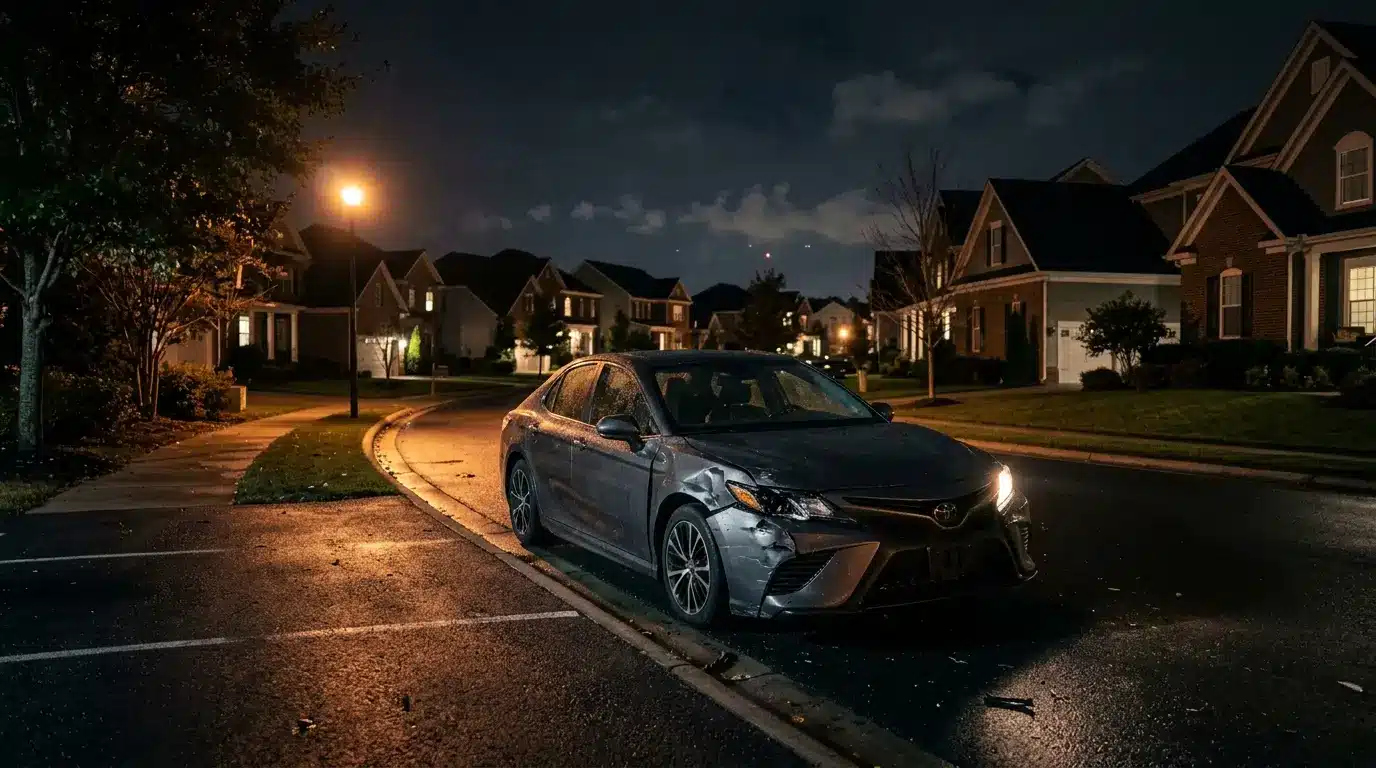
Virginia considers an uninsured driver accident to be “uninsured” in many cases, other than the most obvious ones.
- The at-fault driver didn’t have any liability insurance.
- The driver drove away, and he/she cannot be found; a hit-and-run accident occurred.
- The driver’s insurance coverage company refuses to cover the accident.
- The driver’s insurance company became insolvent.
- The coverage of the driver doesn’t meet the Virginia minimum per Va. Code § 38.2-2206.
For a hit-and-run accident claim, the state of Virginia doesn’t require that the two cars have touched each other per the no physical-contact requirement (hit-and-run). If a driver pushes you off the road but without contact, it can also result in an uninsured motorist claim Virginia, provided that it was reported immediately.
How Does the “John Doe” Claim Work
In case the at-fault driver can’t be found, Virginia gives you the option to sue a defendant known as “John Doe lawsuit / unidentified driver.” You make the lawsuit against an unknown driver and then serve the papers to your UM coverage Virginia insurance company as if it were the defendant.
Then the own insurer as adversary company can represent you in the case instead of John Doe; it means that the company that receives premiums from you defends your case against you.
Factors That Limit Your Maximum Recovery
With respect to an uninsured motorist claim Virginia, your maximum recovery will be the lesser of either your UM coverage Virginia or the total value of your damages. Since you do not have a liability policy in question, your limit under UM will be your ceiling. Here are some factors that will affect your limit:
- The UM policy limits, liability limits unless waived, which are statutorily required to equal your liability limits unless you choose differently.
- Whether you have more than one applicable UM policy, Virginia’s priorities apply to inter-policy / household stacking UM coverage.
- Total value of your personal injury claim damages, including medical bills, projected future medical expenses, lost wages, diminished earning capacity, pain and suffering, and permanent disability.
The insurance company is statutorily required to pay “all sums” / invalid policy set-offs (notwithstanding invalid set-offs) you are entitled to recover, but their efforts to reduce your maximum recovery through policy set-offs are often ineffective.
1 Percent Rule and Why Documentation Prevails
This case falls within the ambit of the pure contributory negligence / 1% rule in Virginia. In the place of the errant driver, your own insurer as adversary UM insurer may assert that you were liable for your injury even by just 1 percent.
This is why proper documentation of the accident and injuries becomes crucial, and also why you need to make sure that the filing period of a two-year statute of limitations § 8.01-243, as per Va. Code § 8.01-243 is not missed. Your insurance company doesn’t need to pay out immediately.
Virginia Victim of an Uninsured Motorist? Call Tatum & Atkinson Law Firm for Legal Help With Your Case

In a situation where the uninsured driver accident defendant was either uninsured or fled the scene following injury, then the claim would fall on the insured plaintiff, and the insured plaintiff’s own insurer as adversary insurance company, would be the other side in your case. It is a fight that you do not want to handle alone.
The experts at Tatum & Atkinson, your trusted Virginia car accident lawyer team, work with uninsured motorist claim Virginia and automobile accident claims in Cedar Bluff. The Heavy Hitters have the skills needed to prove the damages, identify any relevant policies, and ensure payment of “all sums” / invalid policy set-offs even in John Doe lawsuit / unidentified driver cases.
Call (800) 529-0804, or our office at (276) 242-8181. Consultation is completely free.
FAQs: What Is My Maximum Recovery In An Uninsured Motorist Claim In Virginia?
Does a UM claim really go up against my own insurance company?
Absolutely, and it shocks almost everybody. In case the liable party does not have any insurance coverage or is missing, there would be no insurer left to compensate you, and thus, your UM coverage Virginia insurer would step in as its own insurer as adversary. That is why it is important to be cautious when making any recorded statements, while not having a complete understanding of your case situation.
Do I have to prove the other driver was uninsured?
Not really. It is up to you to disprove a positive but not to prove a negative. There are several methods for proving the fact of lack of liability insurance coverage in Virginia, including the certification by the Department of Motor Vehicles of the nonexistence of the required insurance for a certain vehicle, per Va. Code § 38.2-2206. All you need to do is report an accident and preserve the evidence of it.
Will filing a UM claim raise my insurance rates?
This should not happen because the insurance company cannot raise your premiums or cancel your insurance if you were not at fault and used the uninsured motorist claim Virginia coverage, which you have paid for, as stated in § 38.2-1905 (no rate increase).
Can I combine UM coverage from more than one policy?
In some cases. Virginia allows the inter-policy / household stacking of UM coverage Virginia in some scenarios, where the UM coverage from more than one policy can be used in the same accident, such as with the other car in your household. The underinsured coverage operates differently from the UM vs. UIM coverage, and all the policies in the household should be examined before any settlement is made.
What does it cost to hire a Virginia car accident lawyer?
No fees upfront. This type of personal injury claim case is contingent; hence, there are no fees unless there is a recovery, and the first meeting comes at no cost. It counts for a lot in an uninsured motorist claim Virginia case where the valuation of damages, locating every policy that may be applicable, and suing your own insurer as adversary insurance company, no matter the judgment of a John Doe lawsuit / unidentified driver, come under the firm’s jurisdiction, not yours.
