How Do Cars Not See Motorcycles In Virginia?
Key Highlights:
How Do Cars Not See Motorcycles In Virginia?
- In 2023, there were 127 deaths reported as a result of motorcycle accidents.
- Of the deaths from motorcycle crashes, 56% of them were caused by multi-vehicle collisions, where the other driver did not see the motorcyclist in their lane.
- The large majority of motorcycle accidents occur when the automobile turns left and doesn’t see the motorcyclist that has the right-of-way; this is one of the most common types of accidents between motorcycles and automobiles in the state of Virginia.
- The law in Virginia, trying to prevent distracted driving – Va. Code § 46.2-818.2—states that you cannot drive and use your phone; however, a large number of drivers who are using their phones while driving are still a major cause of accidents for motorcyclists.
- Victims seeking motorcycle accident compensation in Virginia may be eligible for payment of their medical bills, lost wages, and pain and suffering if they are able to survive the accident.
They occur year in and year out on the streets and roads of Virginia—an invisible hazard that ought not to be. The question of how cars fail to see motorcycles in Virginia can be answered by analyzing crash evidence, driver behaviors, and the physics of modern vehicular displays. With this knowledge, you will be better prepared for the considerations needed for the protection of your rights after a car vs motorcycle accident in Virginia.
I am an attorney with Tatum & Atkinson Law Firm, and my name is Robert Tatum. Our law firm has a combined over 65 years of experience in the area of representing motorcycle accident victims in Virginia (including accidents caused by blind spots, distracted drivers, and failure to yield) since we opened our doors in 2005 as a veteran-owned company.
Why Motorcycles Are Harder for Drivers to See
Motorcycles can be difficult for drivers to spot on the road due to their small size and limited visibility. According to data compiled from Virginia DMV statistics, many crashes occur on Virginia roads because the driver failed to see the motorcycle until it was too late. This is particularly true when motorcycles are slowed down by heavy traffic and/or traffic controls like signals and stop signs.
- Small Size: Motorcycles use less visual space and, therefore, are less visible than cars or trucks.
- Higher Speeds: As the motorcycle travels on the highway, visibility continues to decrease.
- Turning/Merging: When a driver is preparing to turn or merge, motorcycles can often fail to register as an object that needs to be noticed by the driver.
- Multi-Vehicle Crashes: More than half of all motorcycle fatalities involve multiple vehicles.
- Drivers’ Limitations: The way our brains work causes us to see larger objects first.
- Inattentional Blindness: A driver may be looking for a motorcycle but cognitively filters it out before they actually see it.
Common Causes of Motorcycle Visibility Accidents in Virginia
Visibility errors do not just occur at random; they are based on identifiable patterns. Most motorcycle visibility accident claims that relate to visibility errors can generally be traced to a limited number of identifiable driver behaviors. By being able to identify these patterns, riders who have been involved in an accident can determine why they had an accident and who is responsible.
Blind Spots and Motorcycle Crashes
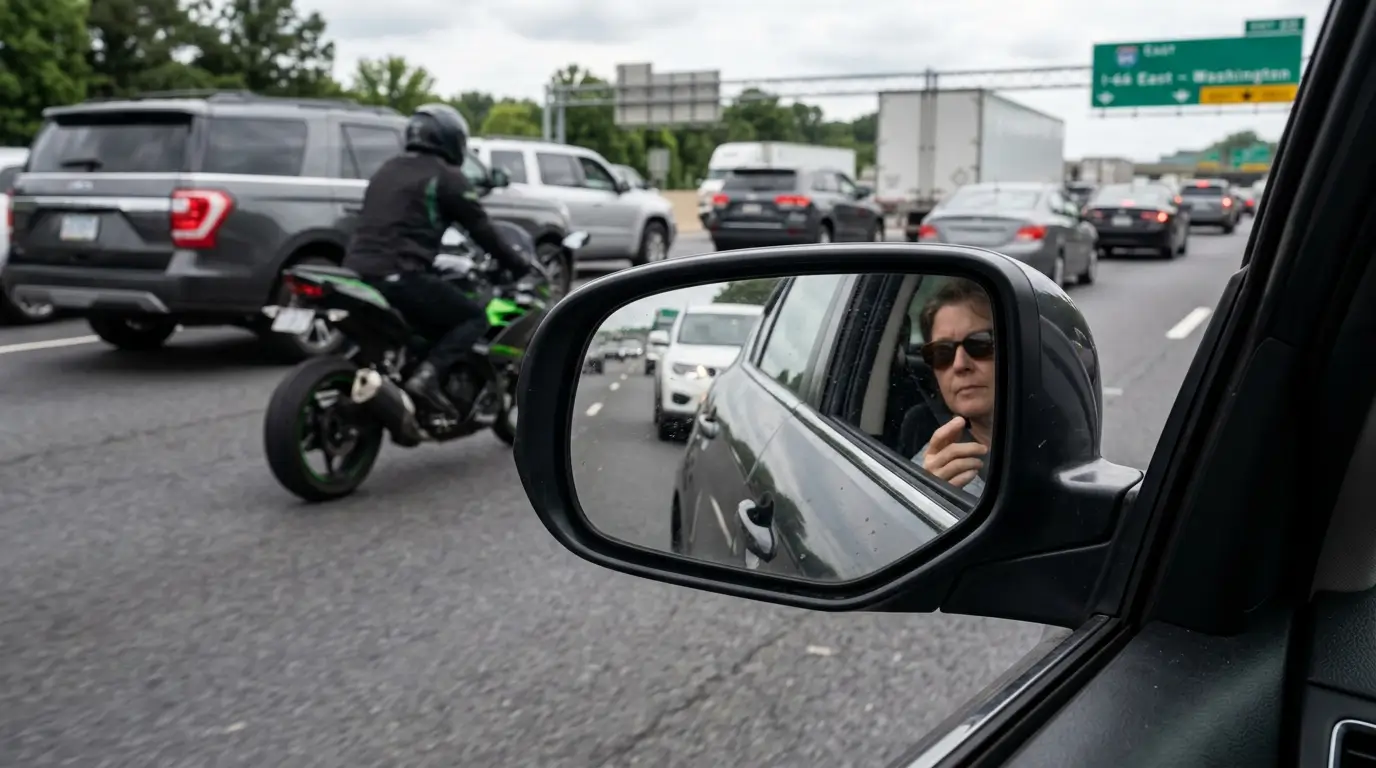
All passenger vehicles have blind spots (areas that cannot be completely seen using mirrors or cameras). When observing blind spots while merging, if the motorcycle is behind or beside the car, the driver may not notice it because of its narrowness relative to the other vehicle. This can cause motorcyclists to be missed by vehicles that are merging into another lane before they merge. Motorcycle blind spot accidents in Virginia are more common on high-speed roads such as interstates and multi-lane roads due to the greater speed of vehicles and the rapid change of lanes compared to slower speeds.
According to Virginia’s traffic regulations, it is the responsibility of all drivers to look at their mirrors and turn their heads in order to see beside them prior to changing lanes. If a driver fails to comply with the requirement to check mirrors and look both ways prior to changing lanes and strikes a motorcyclist, then not performing these actions is an indication of negligent conduct. A motorcyclist who is injured as a result of this negligence is entitled to receive monetary compensation for their injuries and should not be made to bear the financial consequences of the driver’s inattention to the motorcyclist.
Distracted Driving and Motorcycle Accidents
Distractions are one of the leading causes of motorcycle crashes in Virginia. A motorcycle crash caused by distracted driver is the most preventable and most tragic type of crash that can occur on the streets of Virginia today. Since January 2021, all Virginia drivers have been required to comply with § 46.2-818.2 of Virginia’s traffic laws, which prohibits the use of any handheld device while driving, including at a red stoplight. However, this law continues to be ignored by many drivers, and the burden of this inattention generally falls squarely on the back of the injured motorcyclist.
When a driver is operating a handheld device while driving, that driver’s reaction time is severely reduced. For motorcyclists, who do not have much protection in the event of a crash, additional reaction time can be the difference between life and death. The Virginia Department of Transportation has repeatedly reiterated that distracted driving has resulted in dangers to other types of road users and that motorcyclists are the most at risk for injury when this occurs.
Left-Turn Accidents Involving Motorcycles
Virginia has among the highest levels of severe injury or death from left-turn motorcycle accidents in Virginia on roads throughout the state. Left-turn accidents involving motorcyclists occur when a motorist makes a left turn at an intersection into the path of an oncoming motorcycle while the motorcyclist is riding straight through the intersection. Motorists misjudging the speed of an oncoming motorcycle and/or failing to see the motorcycle as they make a left turn into their path results in a left-turn motorcycle accident.
The NHTSA has reported that left-turn accidents are one of the highest sources of fatal motorcycle accidents involving other vehicles. Under Virginia law, all motorists making a left turn must yield the right-of-way to the motorcyclist, and if a motorist fails to do so and strikes a motorcyclist, this is considered a clear failure to yield motorcycle accident. Therefore, all responsibility for the injuries sustained as a result of the left-turn motorcycle accident falls solely upon the motorist.
Virginia Case Study: When Drivers Fail to See Motorcyclists
There are real injuries suffered by actual people in Virginia as a result of motorcycle invisibility, not just statistics, and they act as an illustration of real injuries suffered by people in Virginia. An example of this occurred in Virginia Beach between a driver and a motorcyclist when the motorcyclist struck the motorist, who had the right of way and was updating their lane position. Because of the driver’s poor lookout, the motorcyclist was severely injured, requiring hospitalization, surgical care, and a lengthy rehabilitation process. From a legal standpoint, this motorcyclist will have an action for motorcycle accident compensation in Virginia if the driver’s negligent lack of lookout was the proximate cause of injury.
At Tatum & Atkinson Law Firm, our firm has successfully represented motorcyclists throughout Virginia who have suffered serious injuries as a result of other drivers failing to do a proper lookout when changing lanes or failing to yield. These types of motorcycle accident caused by lane change are winnable when the proper evidence has been properly collected, and the claim is built with due diligence.
How Riders Can Improve Visibility on Virginia Roads
In Virginia, motorcycle drivers are legally responsible for seeing motorcycles; however, many experienced riders take the initiative to improve their visibility through riding gear such as bright and/or reflective clothing in low-light or heavy traffic situations and using headlights at all times, even during daylight, which has been found to greatly improve riders’ visibility even in relatively low light conditions.
Riding within the portion of a lane where motorcycle riders can be seen most easily by a driver in their mirror can reduce the risk of being involved in a side-impact crash; similarly, if riders can avoid prolonged riding within a driver’s blind zone, signal with their horn briefly if necessary and anticipate lane-change moves on the part of a driver, they are less likely to have a riding accident.
Further, it is legal for two motorcycles to ride side-by-side within the same lane in Virginia, thereby increasing their visibility as a group and discouraging dangerous passing from other traffic.
Virginia does not have any current laws that allow for motorcycles to be passed between lanes or between stopped vehicles; therefore, riding outside of a lane is not legal in Virginia and may create another safety or liability concern for motorcycle riders involved in accidents.
What to Do After a Motorcycle Accident in Virginia
A motorcycle accident in Virginia can be an overwhelming event for the victim; you must act quickly to make sure you preserve your health, legal rights, and ability to receive compensation.
Call 911 Right Away
No matter how severe or minor the accident was, you should always call 911 immediately to report it and request emergency services.
Stay at the Scene
Virginia law requires that you stay at the scene of the accident, report it, and assist, if necessary, any parties who have been injured.
Obtain Information
Obtain the other driver’s information, including name, address, telephone number, insurance company, and policy number.
Take Pictures
Take pictures of the accident scene, including where the vehicles are located, any skid marks on the road, traffic signals, road signs, and your injuries.
Do Not Accept Responsibility For The Accident
Do not answer any questions regarding who was at fault before speaking to an attorney.
See a Doctor
See a doctor immediately after the accident, even if you do not feel that you are injured, because you may be injured but not know it.
Preserve Evidence
Keep all records of the accident, pictures of the accident scene, and any medical documents you received as a result of the accident.
Contact an Attorney Immediately
A Virginia motorcycle injury attorney can help you protect your claim, determine who is at fault, and deal with the insurance companies.
Know The Legal Time Limits
Virginia’s statute of limitations allows you to file a case up to two years from the date of the accident.
Why Virginia Riders Trust Tatum & Atkinson Law Firm?
Tatum & Atkinson recognize that a motorcycle accident is more than just a legal issue. It is an emotional, financial, and physical crisis for the motorcyclist involved in the crash. Our Virginia motorcycle accident attorney works on a contingency fee basis, meaning that you pay no fee until we have recovered monetary damages for your injury or loss. Every potential client receives a complimentary consultation where they will explore their options without financial stress.
If you were involved in a motorcycle accident case in Virginia caused by an inattentive driver, someone changing lanes without looking, or an operator making an improper turn that failed to yield the right of way, our experienced attorneys know how to develop the best possible case on your behalf. Call us at (800) 529-0804 now to speak with a member of our team who will help you protect your rights. We look forward to fighting for you!
Why Drivers Don’t See Motorcycles? Book a Call with Tatum & Atkinson to Get Answers
In Virginia, drivers may overlook motorcycles for various reasons, including the size of a motorcycle, blind spots, the disparity in speed, and limitations in their perception of the hazard. Distractions, improper scanning, and disobeying traffic laws, specifically when making a left turn, are some of the main factors leading to crashes involving motorcycle/bicycle operations.
If you have recently been involved in an accident and have suffered an injury as a result of being involved in this type of motorcycle visibility accident in Virginia, don’t wait; contact Tatum & Atkinson for a free consultation at (800) 529-0804. Our motorcycle accident lawyer in Virginia will work with you to help you learn about your rights and to help you begin your recovery process.
FAQs: How Do Cars Not See Motorcycles In Virginia?
What is the 12-second rule on a motorcycle?
The 12-second rule is when you look 12 seconds ahead on the road to give you time to see possible dangers before reaching them.
Is Virginia a no-chase motorcycle state?
There is no statewide no-chase statute in Virginia. Each agency has its own pursuit policy that is dependent on how the officer sees the situation.
Why do bikers tap their helmet when they see a cop?
In the case of a police officer being present, this would be an example of rider-to-rider communication, which essentially alerts all motorcyclists in the area to slow down.
How can motorcyclists stay visible on the road?
Make sure to wear bright reflective clothing, use your headlights during the day at all times, do not ride in the blind spot of the driver, and position yourself so the driver can see you in their mirrors.
Who is at fault when a car hits a motorcycle?
It will depend on the facts of the case; however, typically the driver would be deemed responsible if he/she either (a) failed to yield to the right of way, (b) changed lanes into the motorcycle without checking to see if anyone was there, or (c) was distracted while operating his/her motor vehicle. Being liable depends on Virginia law.
