Why Do Motorcyclists Get Blamed For Accidents In Virginia?
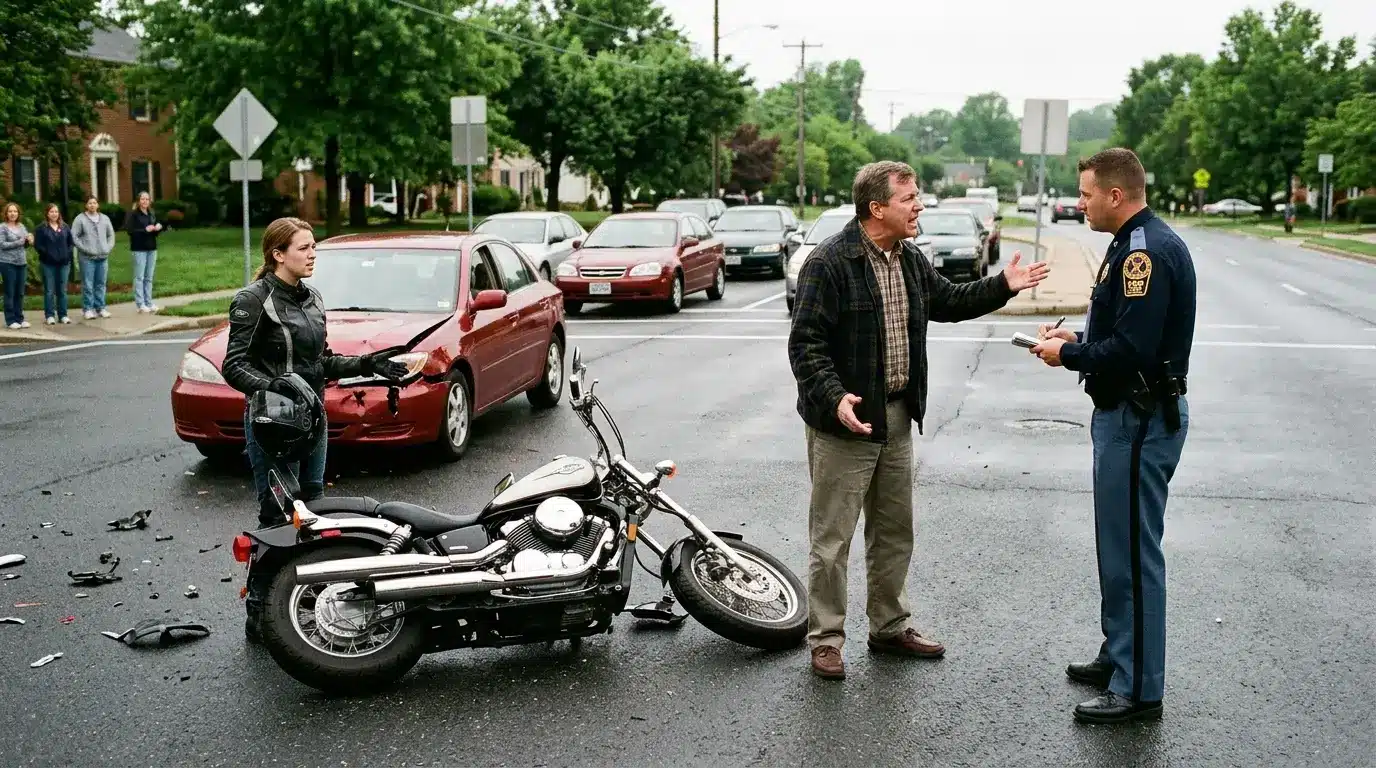
Most people who own bikes and are constantly on the go want to know why do motorcyclists get blamed for accidents in Virginia, so our PI lawyers have prepared a guide for you.
Key Highlights:
- Virginia motorcyclists are frequently subject to stereotypes or assumptions about motorcycle riders being at fault, along with insurance-related tactics. Additionally, the Virginia Contributory Negligence Rule elevates issues surrounding disputing fault to an incredibly serious level.
- Some examples of applicable and useful proof would include photos, witnesses, police reports, videos, damaged gear, and medical records.
- Lastly, motorcycle operators should refrain from making recorded statements, posting to social media, making early repairs to their motorcycle, and failing to obtain timely medical treatment.
- Overall, the key takeaway is to determine fault regarding the motorcycle crash based solely on available evidence, not to make presumptions.
- Motorcyclists in Virginia are often blamed for accidents because of inconsistencies in the evidence and a significant bias against riders.
Unfairly blaming motorcyclists for crashes is too frequent in Virginia, even though there are many times the evidence does not support that view. I am Robert Tatum, an attorney at the Tatum & Atkinson Law Firm. I have witnessed how bias, insurance company tactics, and strict liability laws affect motorcyclists. Being aware of how motorcycle accident liability is determined can help you recover or not recover personal injury compensation from motorcycle accident claims.
The Numbers Virginia Riders Need to Know
The Virginia DOT maintains crash data for motor vehicles; however, they do not break out motorcycle data within the entire data set. However, the data indicates that in 2023, Virginia had approximately 2127 motorcycle-related accidents (an increase of 3.6% as compared to 2022), 125 motorcycle riders killed, and 1719 motorcycle riders injured. Therefore, motorcycle accidents only accounted for 1.7% of all motor vehicle crashes in the state, but motorcycle deaths accounted for 13.8% of all traffic fatalities in the state.
Further, it is interesting to note that it is 37.7% of police-investigated motorcycle crashes, the riders involved took no action that could be deemed to be improper prior to the crash occurring. Moreover, more than 90% of the motorcycle collision victims involved in the nine-month reporting period for 2023 were not under the influence of any intoxicating substances.
Who really causes these crashes? Research shows that in more than 50% of motorcycle collisions with another vehicle, the other driver was at fault. The stereotype of the wild, aggressive motorcycle rider is not backed by crash statistics, but that bias will influence how insurance companies handle claims when they are reported.
Why Does Motorcyclist Blame Happen So Fast?
Imagine the crash scene…
- There is a damaged automobile
- A downed motorcycle
- Perhaps a motorcycle without a rider, on the ground.
- Witnesses to the crash, whether bystanders, the other driver, or sometimes first responders, will all say, “The motorcycle must have been speeding.”
So how do they know that? There is no speed measurement of the motorcycle.
No video recording of the crash.
And no reconstruction of how it happened. Just a guess.
Once that guess is made, it is relayed through the system to the responding police officer and the insurance adjuster, and the written report becomes the foundation of the defense that will be used against the motorcycle rider. Thus, the motorcycle rider must fight a claim based on a story that was created at the time of the incident and is nothing more than one person’s spontaneous reaction to a motorcycle crash.
This is an illustration of motorcycle rider bias at work. Some instances of bias are not intentional, but the result is consistently the same. In Virginia, because of the harshness of its fault law, motorcycle riders can be left with no redress for their injuries before the existence of a legitimate claim has even been determined.
How Virginia’s Contributory Negligence Rule Amplifies the Problem
Virginia is one of only five jurisdictions in the entire country operating under a pure contributory negligence system. Under this legal standard established by Virginia case law and contained in Va. Code Ann. Section 58-1, if you are found to be 1% at fault for a motor vehicle accident, you cannot recover anything from the other party.
Not reduced, barred.
Insurance companies understand this; therefore, motorcycle accident fault determination is highly disputed by insurance companies because it opens up other avenues to reduce their exposures. For example, if an adjuster can establish that you were speeding, were in the wrong lane, or that your equipment inhibited your visibility, they will use those arguments to eliminate recovery regardless of whether they were a factor in the crash.
In addition, Virginia motorcycle accident laws also have a mandate for motorcycle riders to wear helmets as outlined in Va. Code Section 910. If a rider does not wear a helmet, they could use the argument that it caused the rider to have more severe head injuries, even if the helmet did not contribute to who was at fault in the crash. This same legal reasoning applies to both licensing and equipment.
Even though these arguments may not always hold legal merit, they are routinely used. The major legal issue at stake is causation and not just conduct. Did the rider’s conduct actually cause the crash? Or was the insurance company just throwing things at the wall to see if anything would stick?
What Are the 5 Most Common Causes of Motorcycle Accidents in Virginia?
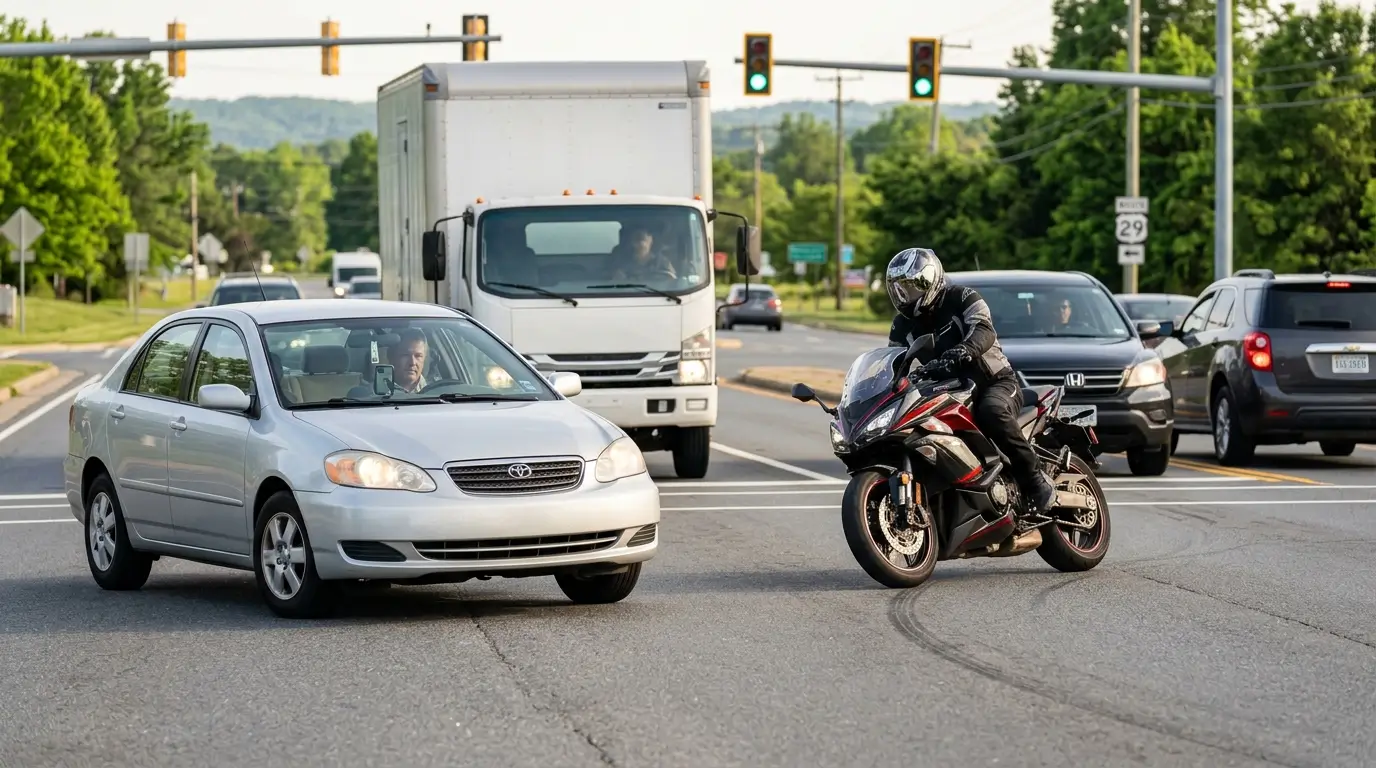
To assign fault correctly, it’s important to first understand how most crashes occur in Virginia. The roadways in Virginia have specific risk patterns based on the type of roadway, such as the traffic congestion found along the 95 corridor in Northern Virginia and Fredericksburg or the beach-intersecting roads from Virginia Beach and Norfolk to the winding roads of the Blue Ridge Mountains and Route 460.
1. Left-Turn Collisions
Left-hand turns are the most common cause of motorcycle accidents. The driver makes a left turn across traffic, misjudges the speed of the motorcycle, or doesn’t see it and hits the rider. Under Va. Code Ann. § 46.2-825, any driver making a left-hand turn has the responsibility to yield to any vehicles that are coming toward them. However, if a driver fails to yield, that driver will be held liable for the accident, not the rider; however, the majority of drivers will say after an accident, “They came out of nowhere.”
2. Distracted Driving
In 2021, Virginia introduced a law prohibiting the use of handheld devices while operating a motor vehicle; however, enforcement of that law is inconsistent. Therefore, many drivers continue to use their handheld devices. The brief amount of time that a driver takes to check their phone is the same amount of time they will likely miss seeing a motorcycle when they are approaching an intersection. This is rapidly becoming one of the leading causes of multi-vehicle motorcycle accidents within Virginia.
3. Blind Spot Failures
Motorcycle riders are easily missed because they are significantly smaller than the majority of cars or trucks on the roadway. Riders are often involved in collisions with vehicles whose drivers failed to check their blind spot prior to changing lanes. Typically, the driver will say “I didn’t see you,” and this is often interpreted as an admission of fault. The driver is required by law to maintain a safe lookout while driving, and if it can be proved that the driver did not, they can be found liable for the accident.
4. Road Hazards and Poor Road Conditions
Motorcycles can easily be thrown down due to poor road conditions (potholes, uneven surfaces, loose gravel, etc.) or road hazards (such as improperly marked construction zones). Sometimes, if the government or its contractors maintain the road and create a hazardous condition, they can also have liability for accidents caused by that condition, even if the accident appears to be a single vehicle collision.
5. Rear-End Crashes
When drivers fail to maintain a proper following distance, they can cause collisions with motorcycles. The motorcycle doesn’t have the same stopping distance as the car does, which will result in a much shorter stopping distance and the possibility of losing control or being thrown down due to the collision. Insurance companies frequently claim that the motorcycle rider braked too quickly; however, this is often simply a tactic used to shift blame from the driver who was not paying attention when they hit the motorcycle.
How Insurance Companies Use Rider Bias as a Strategy
When an insurer evaluates liability for a motorcycle accident liability Virginia, the process is not objective but rather inherently subjective. This means that insurance adjusters will actively search for and identify ways to reduce the value of your claim.
Examples of ways in which motorcycle claims will have their value reduced include:
- Contending that you were “difficult to see” based on your location on the road, the colors you were wearing, or the time of day.
- Contending that you were exceeding the speed limit or travelling faster than the surrounding traffic, without having any measurement or evidence.
- Claiming that you were following too closely or failed to anticipate and/or react to an impending hazard.
- Contending that you were not wearing a helmet or appropriate safety gear, even if you did not sustain any head injuries.
- Requesting a recorded statement from you prior to you having any legal representation or receiving any legal advice.
Rider bias is not evidence but rather noise; the facts matter.
It is very important to remember that you could be speaking to an adjuster who appears to be friendly, but in reality, the friendly demeanor is a strategy used by the adjuster to build a defense for the insurance company motorcycle claims while expressing sympathy for you. This is why all contacts with an insurance company, regarding a motorcycle accident claim, must be handled with caution from the point of first contact with the insurance company.
What Evidence Actually Decides Motorcycle Accident Cases?
Motorcycle accident evidence is essential in creating a strong case vs. an unsuccessful case. The physical documentation of what occurred prior to anyone’s memory fading away or the roads related to the crash is key.
An effective motorcycle crash investigation should compile the following:
Scene Evidence
This includes photographs showing the position of the vehicles, skid marks/debris field, surface conditions, lane markings, signs, sight lines from all angles, helmet/gear damage, and damage patterns of both vehicles.
Digital Sources
These are the types of evidence, such as traffic camera footage, video from a dashcam, security videos from nearby businesses, black box (or event data recorder) data from the other vehicle, as well as recordings from 911 call(s).
Human Evidence
Witness names and statements were taken, establishing current memory. Police report (with any citations, if applicable) and officer’s narrative, though it is noted that this is not always the final word on who was at fault.
Medical and Financial Documents
These include emergency room records, diagnostic imaging, surgical notes, medical therapy records, wage loss documentation, and expert opinions regarding potential long-term effects.
Sometimes, small details may close out a case. For example: Angle of a scratch. A missing side mirror that was located on the wrong side of the vehicle. A camera mounted above the entrance to a gas station. Each element of evidence may cause an insurer’s entire story to be overturned.
What Crash Types Create the Most Disputed Fault Claims?
Crash Type |
Common Blame Argument |
What Evidence Usually Shows |
| Left-turn collision | “The motorcycle came out of nowhere / was speeding.” | Driver failed to yield; Va. Code § 46.2-825 violation |
| Lane-change crash | “Rider was in my blind spot.” | The driver failed to check the mirrors and physically look |
| Rear-end crash | The rider braked suddenly. | The following driver was distracted or too close |
| Intersection crash | Conflicting accounts of light status or speed | Camera footage and an event data recorder often resolve it |
| Single-bike crash | “Rider lost control.” | A road hazard, evasive action, or a third-party vehicle is often involved |
What Mistakes Can Hurt Your Claim After a Virginia Motorcycle Crash?
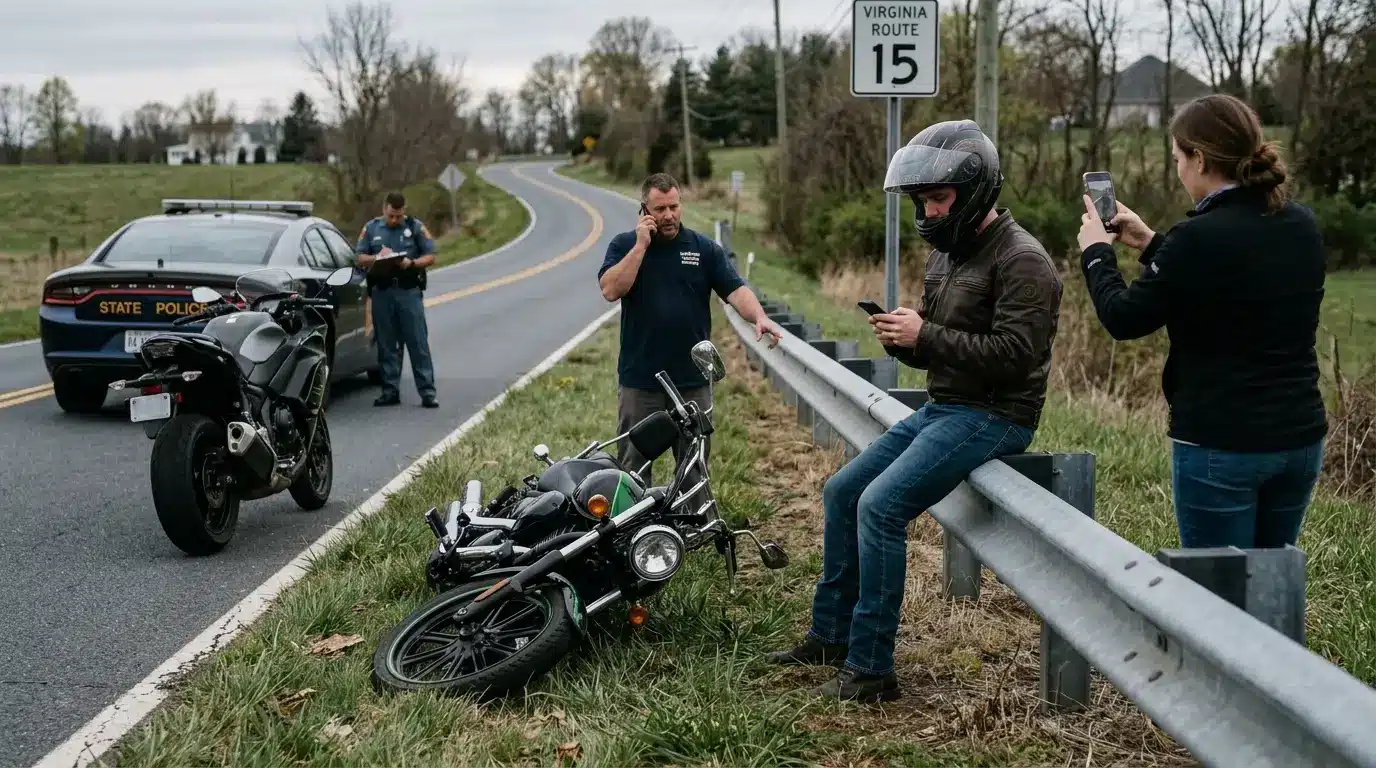
Your actions, or lack thereof, immediately following a crash, will determine whether or not the case is favorable to you. Here are no-brainers:
- Avoid giving a recorded statement without first consulting with your legal counsel. Your tired, off-the-cuff answer can easily end up clipped and used against you. Therefore, don’t do it.
- Do not repair or (if possible) move your motorcycle before the documentation is complete. The damage profile on your motorcycle is evidence of how significant the accident was. You have to preserve the evidence.
- Don’t skip or delay medical treatment. Delays or gaps in your medical treatment create “evidence” that you were not really hurt in the accident.
- Do not post anything related to the accident on your social media accounts. Your pictures, comments, and even check-ins can be used against your claim of injury.
- Do not dispose of any damaged protective gear. Cracks in your helmet, abrasions on your jacket, and damage to your boots can be viewed as evidence of how bad the impact was when you crashed.
- Don’t assume that who is at fault for the accident has been established. The statement of a first responder, an initial police report, or an initial assessment by an adjuster is not necessarily the final position of fault for the accident.
How Does Fault Affect Motorcycle Accident Compensation?
Motorcycle accident compensation in Virginia includes:
- Emergency Medical Care
- Hospitalization
- Surgery
- Rehabilitation
- Medications
- Lost Wages
- Reduced Earning Capacity
- Motorcycle Repair or Replacement
- Pain and Suffering
- Long-Term Disability
All of these compensatory damages will be determined by the specific facts and circumstances of your case.
Virginia motorcycle accident laws place strict liability on a party that can establish using the “contributory negligence standard.” If you dispute an allegation of fault, it can tip the scales from somewhere near all damages awarded to no damages awarded, which isn’t just a minor difference in your case; It can be the difference between receiving any compensation at all or not.
Otherwise, the same evidence foundation will be required for long-term disability compensation claims; that is to say, you will need to show documented causation, clear liability, and expert support that directly relates your accident to your long-term physical and/or mental impairment.
When Should You Speak With a Virginia Motorcycle Accident Attorney?
You need legal help as soon as possible. If you have been in an accident that caused injury, has disputed fault, if someone says they “didn’t see” you, or if the police report seems inaccurate, or if your insurance carrier is trying to get you to provide a quick recorded statement. You need assistance right away. Evidence will go stale over time due to the changing road conditions after only hours of an accident; security camera footage is overwritten every 30 days, and witnesses forget very quickly. Another driver’s insurance company starts building its defense the moment it receives notice of the crash.
Early legal assistance can preserve the evidence before it is too late and can protect you from providing statements that will make your claim more difficult to prove.
In Virginia, the statute of limitations on general personal injury claims is 2 years from the date of the crash under Virginia Code § 8.01-243. However, the statute of limitations may be different for certain facts, parties, or government entities involved with the crash. Do not assume that you can wait to hire an attorney.
Bias Is Easy. Proof Takes Work.
Motorcyclists often bear the brunt of other people’s assumptions. Insurance companies are aware of this, which is why they have developed entire claims strategies based on it. As such, a motorcycling accident claim in Virginia should never be decided based upon some random witness statement or stereotype about motorcyclists; rather, it should be based on evidence: the road, the vehicles involved, any videos, the statement of the witnesses, and the legal standards applicable to every motorist in Virginia.
If you have sustained an injury due to an accident, please remember also that preserving evidence is critical for future reference. Roads will be cleared within a few hours; however, the claim process can take many months to settle.
Talk With Tatum & Atkinson About Your Virginia Motorcycle Accident Claim

If someone else was determined to be at fault for a motorcycle crash that occurred within the state of Virginia, the Tatum & Atkinson Law Firm can review the facts, question the conclusions, and work with you to deal with the insurance company from a position of strength.
A call to (800) 529-0804 will give you a free consultation, and there is no fee unless there is a recovery. There is only straightforward advice when you need it most.
FAQs: Virginia Motorcycle Accident Blame!
Can wearing dark clothing affect a motorcycle accident claim in Virginia?
Insurers can increase it, but clothing alone cannot determine fault; however, road conditions, the degree of the driver’s concentration, light conditions, or other factors present at the time of the accident will have more weight in determining fault legally.
Can a motorcyclist be blamed even if another driver violated traffic laws?
Insurers can also contend that multiple parties may share the blame in Virginia; however, the plaintiff must show through evidence that the other driver’s tortious conduct caused the automobile accident and not just that it occurred.
Do larger vehicles automatically have the right of way over motorcycles?
Motorcycles enjoy the same rights on the road as any other vehicle, and the size of a motorcycle does not give it any legal preference or priority on the road under Virginia law.
Can helmet use affect fault in a Virginia motorcycle accident case?
In Virginia, state law requires that all riders wear helmets as provided in Virginia Code § 46.2-910. Although the issue of whether to wear a helmet may be significant in resolving a lawsuit or determining culpability for an automobile accident, it is not determinative of causation in connection with an automobile accident.
What should I do if a witness wrongly blames me for the motorcycle accident?
As soon as possible following an accident, document your version of events (i.e., your view of things), identify and contact any additional witnesses, obtain and maintain any photos or videos of the accident scene and injury, and talk to an experienced traffic attorney before the incorrect version of the accident becomes accepted as the only version of record.
