How Does Texting And Driving Cause Big Truck Wrecks In Virginia?

Key Highlights:
- Proving a texting and driving truck accident Virginia, it is important to act fast to secure evidence such as cell phone records, electronic logging device data, and black box information from the truck.
- Texting is three distractions at once: visual, manual, and cognitive distractions, which makes it lethal.
- Federal rules flatly ban texting and forbid commercial drivers from using handheld mobile devices.
- The trucking company’s insurance provider will try to pin 1% of the fault on you.
A driver who is texting diverts their attention, sight, and concentration all at the same time and as a result, if they are driving an 80,000-pound truck, the few seconds they lose may lead to a car accident or crash that would be avoided. Texting and driving truck accident Virginia, there are terrible consequences for other road users. If you happen to have suffered from the negligence of truck drivers and their texting, then a highly qualified team from Tatum and Atkinson Law Firm will provide you with the legal assistance you need for compensation.
Call Tatum and Atkinson Law Firm at (800) 529-0804 right now for a consultation that is free of charge and has no obligations attached.
Three Ways a Text Distracts a Driver
According to safety experts, distraction can be divided into three types: visual (when sight is diverted away from the road), manual (when a hand is away from the steering wheel), and cognitive (when thinking is not concentrated on driving). While most forms of distraction involve one of these types, texting involves all three of them simultaneously.
Studies authorized by the Federal Motor Carrier Safety Administration indicate that a commercial driver who texts is twenty-three times more likely to be involved in an accident or near-accident, having taken their eyes off the road for an average of 4.6 seconds, which equals over a hundred yards when the speed is 55 mph.
Why Distraction Is Deadlier in a Big Truck
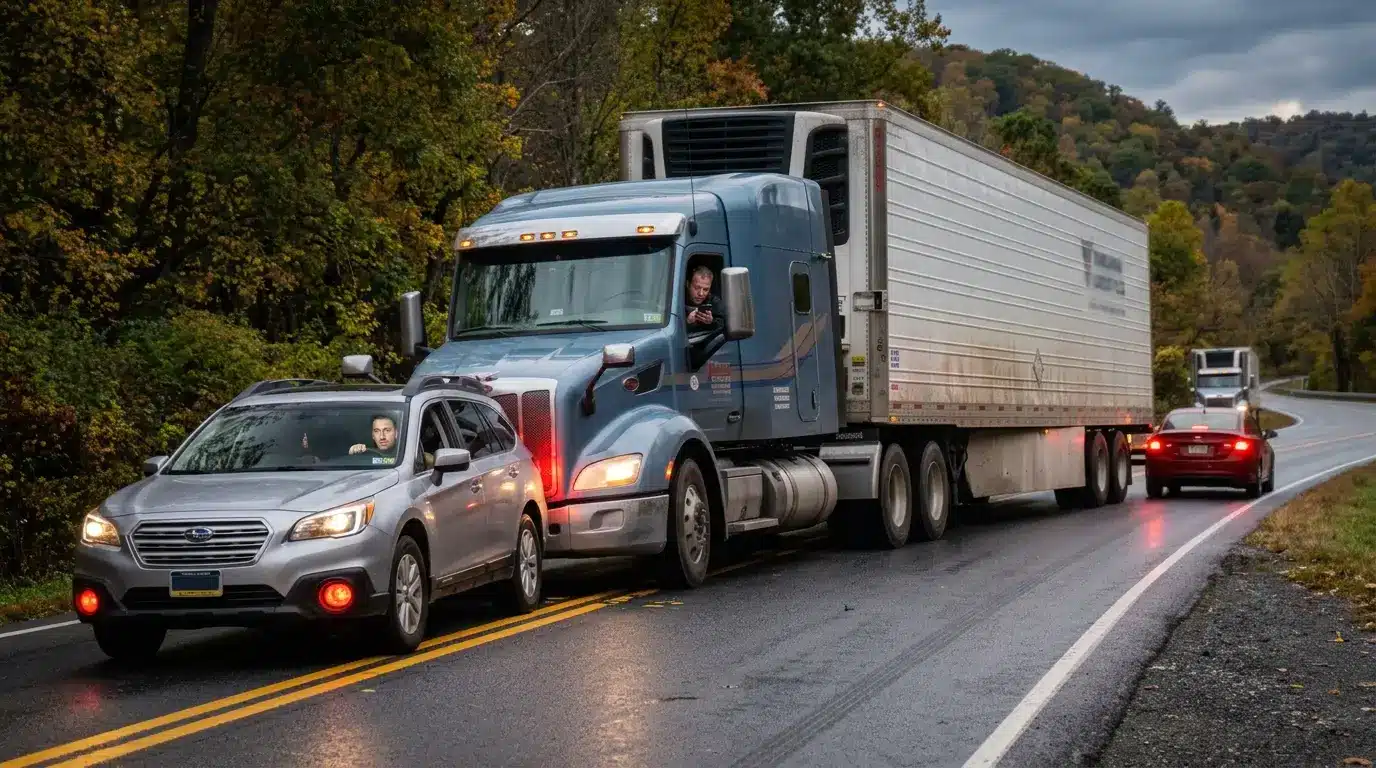
A fully loaded 18-wheeler cannot stop like a car; once on the highway, it will need a few hundred feet to stop completely. With just a few seconds of distraction from a cell phone, the driver eliminates that distance. The resulting accident scenarios are:
- Rear-end crashes because the driver fails to notice the slower vehicles ahead of the truck.
- Lane drifting and side-swipe crashes due to the truck drifting out of its lane.
- Jackknife incidents that result from abrupt or sudden braking.
- Truck crashes resulting from the car becoming stuck under the trailer.
- Accidents that cause multiple-vehicle collisions on busy highways like I-95 and I-81.
Federal and Local Rules Regarding Texting and Driving Truck Accident Virginia
Distracted truck drivers typically violate two sets of regulations at the same time. The federal regulations (49 CFR §§ 392.80 and 392.82) prohibit commercial drivers from using mobile telephones and prohibit trucking companies from requiring or permitting it. That would be a violation costing drivers as much as $2,750 and carriers as much as $11,000 under federal law. The Virginia law (Va. Code § 46.2-818.2) also makes it unlawful to hold any handheld device while driving. Violation of one of the two regulations provides significant proof of negligence in the commercial truck accident claim.
Who Is Liable, and How Is Distraction Proven
The driver isn’t the only one who’s at fault: a company that communicates with its driver using a fleet app could be held liable too, which means the records of dispatch and fleet messaging can be presented as evidence. To show that the driver was distracted, one needs to do a truck accident investigation and collect certain evidence that quickly becomes unavailable, such as cell-phone records with precise time stamps, telematics and logging data, video clips from dashcams, eyewitness accounts, and accident reconstructions.
A successful claim can help a victim recover payment for medical expenses, future treatment, loss of wages, incapacity to earn money, suffering, and damages; there is no cap on such expenses in Virginia law (there is only a cap on punitive damages which is $350,000 under Va. Code § 8.01-38.1).
Virginia’s Pure Contributory Negligence Statute and Deadline
Virginia’s contributory negligence law is very strict; if even 1 percent of blame can be pinned on the victim, that person cannot recover damages. That is why it is important to secure the truck and phone records as soon as possible. The statute of limitations for lawsuits in Virginia is two years, according to Va. Code § 8.01-243, but evidence can disappear in that time frame.
Hurt by a Distracted Truck? Get the Heavy Hitters on Your Side

If you or your loved one has been injured by a truck driver who was using a phone, then the time limit for gathering evidence has already started running. To create a solid case after a texting and driving truck accident Virginia, it is necessary to act quickly to get hold of all phone records, communications related to the fleet, and logs kept by the company that owns the truck.
At Tatum & Atkinson, our Virginia truck accident lawyers are ready to help injured individuals across the state from our Cedar Bluff office. We know what it takes to make negligent drivers accountable and safeguard our clients’ interests in the future.
Give us a Call (800) 529-0804 for a free consultation.
FAQs: How Does Texting and Driving Cause Big Truck Wrecks in Virginia?
How can anyone prove the trucker was texting?
Evidence comes from pure facts (data collection) and not any assumptions. An attorney is able to obtain the driver’s phone records, which give a full account of calls and messages made. This information can be used in conjunction with telematics information, the dashcam footage, and statements from bystanders.
Can the trucking company be liable for its driver’s texting?
Yes. FMCSA texting rules prevent the carrier from allowing the driver or the carrier to use a phone to send instructions to the driver while he is in motion. Such information is available via discovery, and if it shows trucking company liability in a particular case, the liability may exceed that of the driver alone.
Is the driver off the hook if they used a hands-free device?
Not necessarily so. Though hands-free operations are allowed, cognitive distraction persists, and the mind is still partly off the driving. The hands-free driver causing the accident can be held negligent even if he did not break any rules. The essence of the matter is whether the driver managed the truck in a proper manner, rather than finding out if a rule was broken.
What if I was a little distracted too?
Virginia imposes a rule of contributory negligence that prevents you from recovering your compensation even if you are only 1% at fault. The insurance companies might find the reasons for blaming you and call you negligent or speeding. Yet, this does not mean that your claim is rejected. The best solution in this case is to avoid culpability and consult with a lawyer first while focusing on the facts.
What does it cost to pursue a distracted driving truck claim?
No payment is made in advance. It is charge-free until the case is successfully done and the plaintiff receives their compensation. In the case of a distracted driving truck accident claim, additional expenses should be incurred since the plaintiff will need the experts’ help. The sooner the client calls the law firm, the sooner the lawyer will manage to send the necessary requests in order to protect evidence.
