What Is A Jackknife Truck In Virginia?

Key Highlights:
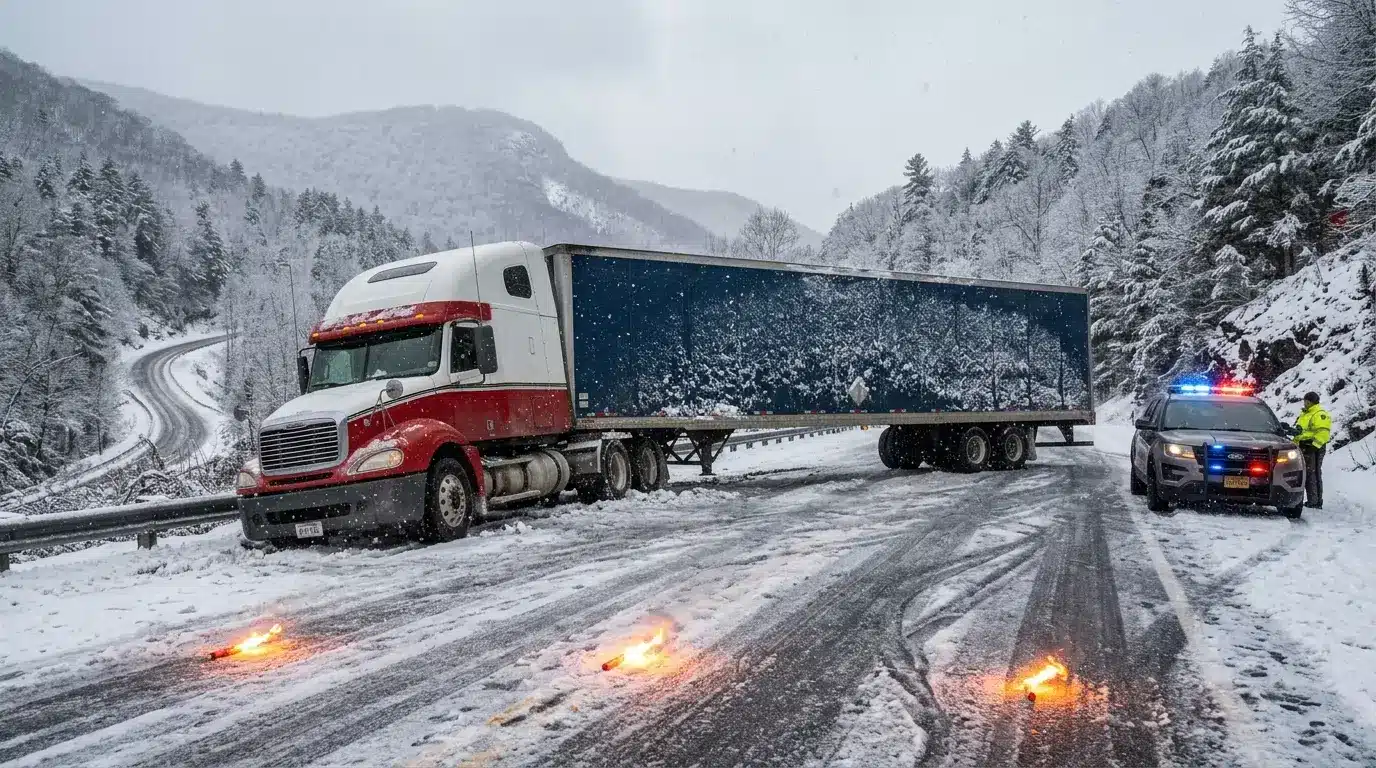
- Jackknife truck in Virginia accidents occur when the trailer and the tractor stop being in line, and the trailer swings out.
- In Virginia, with its 1% rule of fault, the insurance company will try to find anything to pin on you.
- For the Jackknife truck accident Virginia, a jackknife tractor-trailer is a semi-truck whose tractor and trailer have folded into each other.
- It is such that the trailer has swung outward, forming an acute angle with the tractor in the form of a folding knife.
- On the Virginia road, that swinging trailer occupies several lanes at once and typically creates a lot of trouble.
The fact that a jackknifing tractor-trailer can occur in a split second means that the effects of the accident might stay with you all your life. This is Robert Tatum, the founding lawyer at Tatum & Atkinson Law Firm.
Our veterans’ legal firm has more than 65 years of combined experience dealing with cases involving jackknife truck accidents in Virginia and truck accidents in general since our inception in 2006. Our Virginia truck accident lawyers will know exactly how to handle your case using black box information and FMCSA laws.
What Really Occurs During a Jackknife
A semi-truck consists of two vehicles joined through a pivoting point referred to as the fifth wheel. In case the wheels of the trailer start to slip while the cab keeps going forward or vice versa, and the wheels of the tractor lock, the two halves get decoupled and continue their movement separately, folding one another with force at an acute angle. There are two types of jackknives:
- trailer jackknife truck (trailer swings out) and
- tractor jackknife (cab moves sideward).
Jackknife Accident Causes in Virginia
The primary reasons for a tractor trailer accident can be related to the following factors associated with how the truck was braked, loaded, or maintained:
- Abrupt braking causes the wheels to lock and lose traction
- An imbalance of the braking system or a brake failure, where the trailer brakes engage more than those on the tractor
- Excessive speed while driving in rainy, icy, or wet conditions, and while making turns on slopes on highways such as I-77 and I-81
- Inappropriate loading of the cargo in the trailer
- Tire blowouts, old brakes, and other mechanical defects.
Why Jackknife Incidents Cause Severe Damage to Others
During a jackknife truck incident, the trailer moves sideways, and the speed of the truck, weighing 80,000 pounds, leaves no time for other drivers to react. When a commercial truck accident occurs on a freight route such as I-81, I-64, or I-77, there is a chance of causing a chain reaction crash within a few seconds.
According to the Federal Motor Carrier Safety Administration, the collision with another vehicle is the first event to occur in most large-truck crash fatalities.
Injuries and Things Covered in a Claim
The accidents create catastrophic injuries such as the following:
- traumatic brain injuries
- spinal cord injuries
- whiplash
- crush injuries
- bone fractures, and
- at the worst-case scenario, death.
In a Virginia accident claim, one may be able to recover for present and future treatment, loss of income, decreased ability to earn, pain and suffering, and property damage. There is no limit on these damages in a typical case in Virginia.
Liability and Evidence of Liability
The trucking company liability will be extended beyond the driver to the trucking company due to poor maintenance of the truck or failure to conduct a safety check of the brakes, loading crew, mechanic, and manufacturer of the brakes or tires.
These are all pieces of evidence that are easily lost:
- logging data
- black box data information
- brakes and maintenance logs
- driver qualification logs
- dash cam footage, and
- reconstruction.
FMCSA regulations require trucks to have safe braking systems, and this is important in proving negligence.
The Virginia’s One Percent Rule
The rule of pure contributory negligence is the law in Virginia, where a person is not entitled to recover anything in case an insurance company proves that 1 percent of the fault belongs to him. The statute of limitations in Virginia provides a period of two years; however, all the evidence expires long before that time.
Injured In a Virginia Jackknife Truck Crash?

If a jackknife truck caused you or one of your loved ones injury, you’re facing off against the trucking company and its insurance company. Getting an evaluation is free, and the earlier you do it, the more evidence we can preserve.
The firm of Tatum & Atkinson, your trusted Virginia truck accident lawyer team, serves victims of tractor trailer accident cases in Virginia and operates out of our Cedar Bluff office, which handles southwest Virginia cases. The Heavy Hitters are experts at interpreting the story told by a jackknife truck accident Virginia, brakes, speed, cargo load, and proving it through the records.
Call toll-free (800) 529-0804 or the Cedar Bluff office for a free case review.
Frequently Asked Questions!
Could the truck driver have prevented the jackknife?
Usually, indeed. Adequate following distance, proper speed, good braking, and proper brake maintenance prevent most jackknife truck incidents, so the jackknife is usually evidence of some mistake. Locating the cause is likely to require the truck’s maintenance records and the assistance of a reconstructionist.
Is a jackknife always the truck driver’s fault?
No, the driver would be liable, but not exclusively. Brake malfunctions could arise due to trucking company liability, mechanic error, trailer imbalances because of improper loading, and faulty parts because of the manufacturer’s liability.
What if I could not avoid hitting the folded trailer?
There might be a case. A tractor trailer accident blocking the lanes becomes a sudden hazard that the following drivers are unlikely to have time to avoid, and just hitting the trailer is not necessarily your fault. You need to keep the evidence.
Does the truck’s anti-lock braking system matter to my case?
It can. The anti-lock braking system prevents wheel lockup while braking, which is one of the primary causes of a jackknife truck incident. When a truck’s ABS is disabled or not working or noted in an inspection, and nothing is ever done about it, that will bolster the case against the company per FMCSA regulations, and so those records need to be obtained before they are lost.
What does it cost to pursue a jackknife accident claim?
No cost up front for truck accident investigation case. This type of case operates under contingency fees; there is no payment unless there is a recovery, and the first consultation is free. It does take money to investigate a commercial truck accident, however, and so the firm front-loads. Contact a Virginia truck accident lawyer today.
