What Should You Know About Steering Failure Truck Accidents in Virginia?

Key Highlights:
- The steering failure truck accidents in Virginia occur when the driver loses all control over the truck.
- This does not usually happen unexpectedly, and therefore, there is the suspicion of negligence.
- The truck maintenance and inspection records play a crucial role in the processing of the case.
- The stopped truck needs to be preserved as soon as possible since it is one of the main pieces of evidence.
Loss of steering is among the most frightening things that happen while driving: the steering wheel is turned, but the vehicle does not respond. An 80,000-pound vehicle traveling at a fast pace can cause a devastating collision.
If you or a family member encountered the terrible consequences of a steering failure truck accident in Virginia, make sure to get the assistance of the professionals from the Tatum & Atkinson Law Firm, who know how to help you receive the compensation you deserve.
Schedule an appointment at (800) 529-0804 with Virginia truck accident lawyers to protect your rights today!
What’s a Steering Failure Truck Accident in Virginia and Why Does It Happen?
Loss of steering means that there is a malfunction between the steering wheel and the wheels of the truck. This could happen as a result of the failure of the gear system, linkages, or hydraulic steering. In such cases, the truck would no longer move anywhere the driver intends. Here are some reasons for steering failure:
- The steering link, such as tie rods, ball joints, or pitman arm, is worn out or broken.
- Loss of power steering due to a failed pump, a broken hose, or a lack of fluid.
- Broken or malfunctioning steering gear.
- Suspension issues affecting steering ability.
- Neglected maintenance or poor repair.
- Faulty or incorrectly manufactured steering part.
The Crashes and Injuries That Follow
A truck can be involved in very serious accidents due to steering failure. Included in this are jackknife accidents, lane departure accidents when the truck leaves its lane, head-on crashes when the truck crosses over to the opposite lane, rollover accidents, and accidents involving collisions with other vehicles.
Following such accidents, individuals involved experience a variety of catastrophic injury including, but not limited to, traumatic brain injuries, spinal cord injuries, fractures, injuries to the internal organs, etc.
Who Is Responsible When Steering Fails
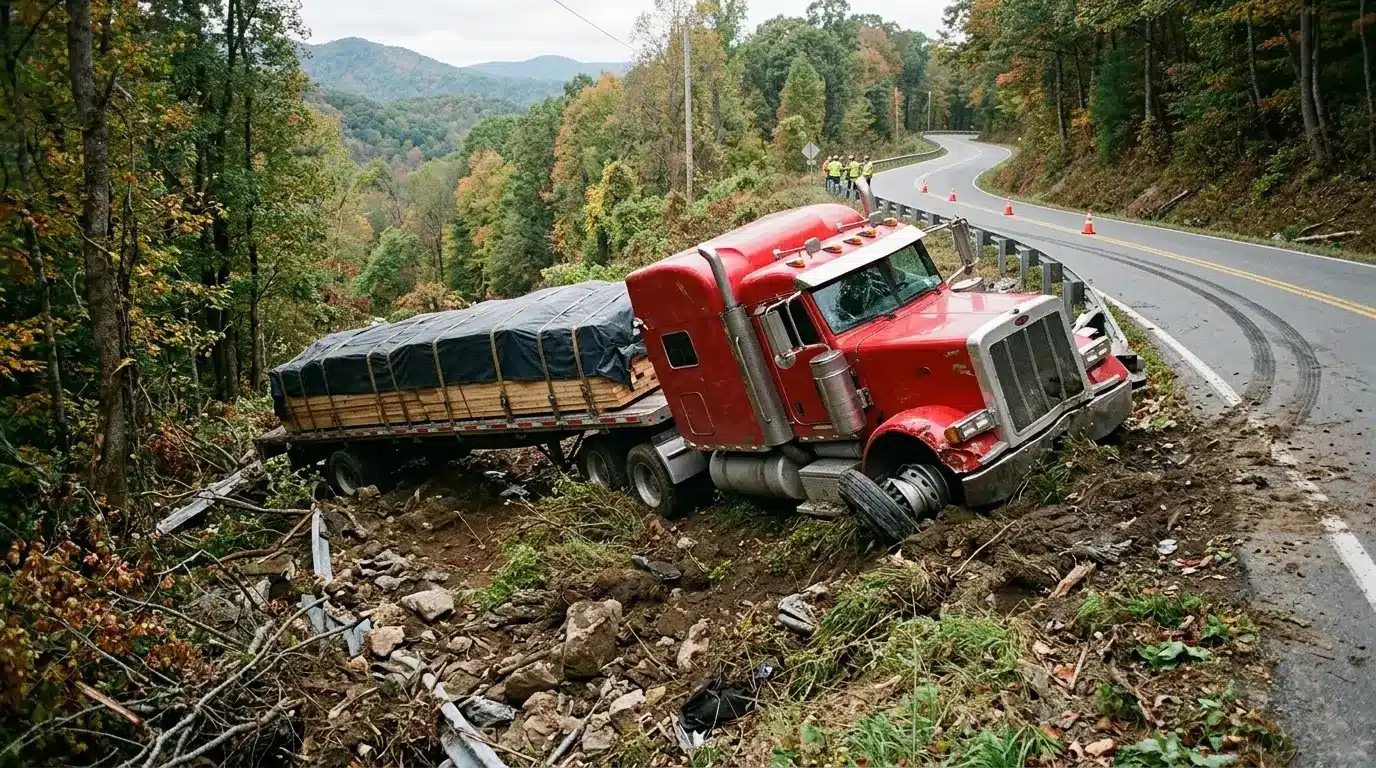
The majority of steering failures do not occur unexpectedly, which means that liability lies with someone responsible for ensuring the safety of the truck. The party at fault may be:
- There is a trucking company liability for neglecting to do inspections or ignoring a problem.
- A mechanic or repair garage for faulty repair or not noticing an issue.
- The driver for driving an unsafe truck.
- The manufacturer of the part if the problem is with the steering component itself.
FMCSA Regulations and the Records That Prove the Case
According to 49 C.F.R. § 396.3, carriers must inspect, fix, and maintain their trucks regularly, and this regulation lists steering systems specifically among the systems needing to be maintained safely. The requirement generates a paper trail, which is the proof, too.
The evidence comprises records about maintenance and inspection methods and their particulars, invoices for carried out repairs, driver vehicle reports, data from electric log devices, and expert evaluation of faulty elements. Nevertheless, most of this evidence is kept for short time periods, and the damaged truck may either be repaired or discarded before any investigation is completed.
Virginia’s 1% Rule and What You Can Recover
Virginia operates under pure contributory negligence, meaning that the defense will likely attempt to show that the injured party shares in the blame, even if it were only one percent, which would derail your claim. Therefore, it is essential for the evidence about the truck mechanical failure to be established. This evidence allows claiming compensation for current medical payments, future medical payments, loss of wages, loss of ability to earn income, and damage of property according to Virginia law.
Such cases usually revolve around experts who perform engineering and reconstruction work to determine the cause of the failure. The statute of limitations for accidents is two years from the date of the accident, according to Va. Code § 8.01-243.
Injured by a Steering Failure? Our Virginia Truck Accident Lawyers Can Help.

A steering failure truck accident in Virginia is hardly a mere coincidence; it indicates that safety was compromised. You should not have to prove your case while recovering.
In our Tatum & Atkinson Cedar Bluff office, attorney Jon Ward works on behalf of clients seeking compensation for commercial truck accidents in Virginia. Our Heavy Hitters move quickly to prevent evidence from being lost, conduct investigations with leading experts, and take on the insurance companies.
Call (800) 529-0804 now for your free consultation. You won’t pay anything unless we win!
FAQs: What Should You Know About Steering Failure Truck Accidents in Virginia?
How do you prove steering failure caused the crash and not driver error?
The failure of the steering mechanisms can be determined by examining physical evidence. A competent mechanic or engineer determines whether there was a mechanical failure or a defect in the steering mechanisms that existed before the crash.
What if the steering part was defective from the factory?
A malfunctioning component can be a basis for a claim alleging product liability against the producer and can also be the basis for a claim asserting maintenance negligence against the firm or repair center. In some cases, both liability claims may be relevant. A lawyer will identify the potentially liable parties and will assert all available claims.
Why is preserving the truck so important?
The broken steering components might possibly serve as the major piece of evidence illustrating how the accident occurred. If the truck is fixed, sold, or dismantled, the evidence would be lost. It is essential to file a preservation request as a way to protect the evidence.
Can we still recover if the driver we were with was partly at fault?
Virginia’s 1% law completely bars an at-fault driver from recovering compensation. However, as an innocent passenger, your right to recover is protected. Because you had no control over the vehicle or its maintenance, you can still pursue a claim against the negligent parties who caused the safety failure.
What does it cost to hire a Virginia truck accident lawyer?
There are no costs involved until the case is settled. The case is on a contingency basis, so you can expect no charges unless compensation is received.
