What Happens If A Loved One Was Killed In A Rideshare In Virginia?
Key Highlights:
- If your loved one was killed in a rideshare in Virginia, the case brings into consideration a corporate entity and several complicated insurance contracts, which only makes the situation more painful.
- The amount of coverage that applies depends on which stage the respective driver’s app was at the time of the accident.
- In Virginia, the claim for wrongful death is filed by the representative of the deceased person’s estate on behalf of the remaining family members.
- The app can quickly overwrite the relevant data, making it important to act quickly in such matters.
The death of someone dear to you in a rideshare accident can be devastating and made worse by the challenges of dealing with insurance policies and investigating liability. This article provides an overview of cases of rideshare wrongful death in Virginia arising out of accidents involving companies such as Uber and Lyft.
Wrongful death lawyer Virginia at Tatum & Atkinson Law Firm has the skills to work through these complicated cases in order to protect your family’s rights.
We are here for you. If you’d like to receive a free consultation, please call us today at (800) 529-0804.
What Makes a Rideshare Wrongful Death in Virginia Case Different
A wrongful death claim usually arises when the death of a person is caused by the negligent act of another.
Accidents involving ridesharing come with an added complication: the involvement of a transportation network company (TNC), a tracking application, as well as various insurance policies.
The causes of these accidents are predominantly the same: distracted driving, speeding, driving while impaired or fatigued, reckless driving, or poor vehicle maintenance.
Who May Be Responsible
In many cases, a fatal rideshare accident Virginia may not be the fault of a single person but of several parties, such as:
- The rideshare driver, if his or her negligent actions led to the accident
- The driver of the other vehicle that hit the rideshare vehicle
- The rideshare company’s insurer, if applicable to the driver’s mode of activity
- The manufacturer of vehicles or their parts, if defective parts played a role
- On some occasions, others such as the employer or the road construction company.
How Rideshare Insurance Works the App-Status Puzzle
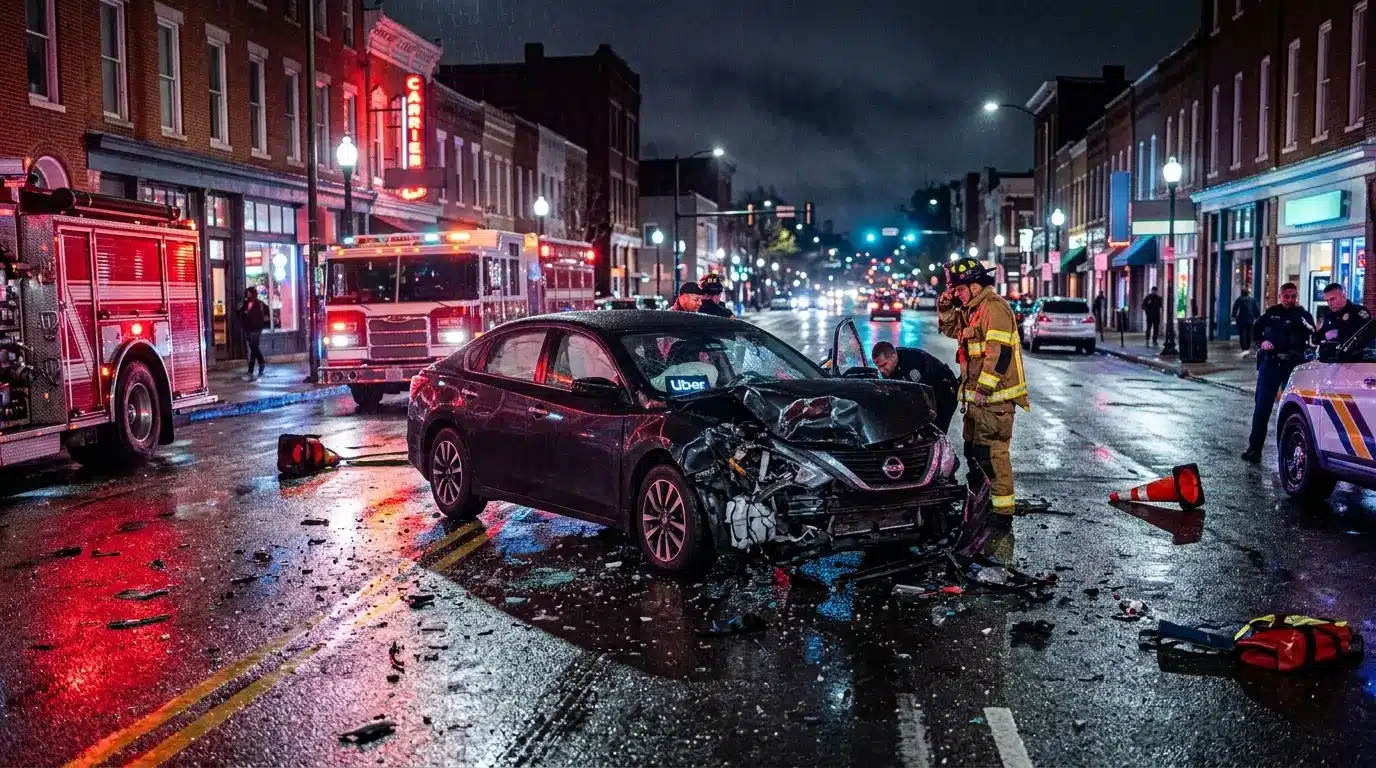
The type of insurance depends on the status of the driver at the time of the accident. Three categories are delineated in Virginia law under Va. Code § 46.2-2099.52:
- App turned off: The driver’s personal auto insurance applies.
- Logged into the app but waiting for orders: Requires a minimum of $50,000 per person and $100,000 per accident for bodily injury and death as well as $25,000 for property damage.
- While accepting rides until they are dropped off: This category requires $1 million liability coverage and UM/UIM coverage.
This demonstrates why establishing the exact status of the driver, often down to the minute, is crucial to establishing the outcome of the case. The Virginia DMV has published the requirements, and the law mandates that the ridesharing company provide the precise data regarding the driver’s log-in and log-out times.
Who Can Bring a Virginia Wrongful Death Claim, and What It Can Recover
In Virginia, a personal representative of the estate files a wrongful death claim in favor of its legal heirs, including usually a spouse and children, depending on who survived.
Recovery under Va. Code § 8.01-52 would include costs for funeral and burial, medical expenses incurred from the last injury, earnings provided by the deceased, and grief and pain suffered from his or her death. Virginia applies the pure contributory negligence rule, according to which if even 1 percent of negligence belonged to the deceased, that means the claim will not succeed at all.
The Evidence and Why the App Data Disappears
Proving the grounds for both fault and the driver’s app status requires quick evidence collection in the form of a police report, trip logs from the app, GPS and vehicle data, cell phone records, witness accounts, nearby camera surveillance, and accident reconstruction.
According to Virginia law, this company has a duty to act appropriately by providing the correct log-in and log-out times, but the only way to make this happen is to act before the records are lost.
Lost a Loved One in a Fatal Rideshare Accident? Tatum & Atkinson Can Assist You.
There is no way to fill the void left by a lost loved one. Nevertheless, filing a claim for rideshare wrongful death in Virginia can help to bring the responsible parties to justice and prevent your family from facing issues related to insurance at such a difficult time.
We at Tatum & Atkinson are located in Cedar Bluff and known for our expertise in wrongful death lawsuits in the southwest Virginia region and is operated by attorney Jon Ward, who is licensed to practice law in Virginia.
Our firm will act quickly to ensure that vital app and vehicle data is preserved, while also making sure all applicable insurance policies are found and that the Uber accident attorney rejects any allegations of contributory negligence made by the insurance company.
Should you have any questions on the matter of rideshare wrongful death claims in Virginia, don’t hesitate to contact our Lyft accident lawyer at (800) 529-0804 for free consultations.
FAQs: What Happens If a Loved One Was Killed in a Rideshare in Virginia?
How long do we have to file a wrongful death claim in Virginia?
As a general rule, it must be done within two years of the death, as per the provisions set forth in Va. Code § 8.01-244. Indeed, while grieving families might feel that two years is a long time, the evidence needed to settle a rideshare case, such as the app data that shows the driver’s state, would have been lost long before that.
The motorist only had the app open and was not in possession of any passengers. Will there be any insurance coverage applicable here?
Usually, yes. Ridesharing companies in Virginia are required to provide liability insurance for drivers even when there is no ride request yet; however, the limits of insurance coverage are lower. Insurance companies have a tendency to incorrectly cling to the assertion that it is the driver’s personal insurance that is applicable only.
In case our family member is partly responsible, can we still claim?
Virginia is bound by the rule of contributory negligence rule. This causes a person to be denied recovery if found even 1 percent at fault. A careful investigation is necessary to prove that the death was entirely someone else’s fault.
What if another driver, not the rideshare driver caused the crash?
The insurance from the driver in question is often a logical first port of call, but seldom the final destination in such cases. If, for some reason, the driver was underinsured, the rideshare company’s coverage may provide compensation for damages to the passenger.
What does it cost to hire a Virginia wrongful death attorney?
No up-front fees. This means that no expenses are incurred unless a settlement is reached on the claim. The company pays for the costs of case development and allows families to concentrate on grieving and learning what their legal choices are.
