What If I Was A Pedestrian In A Car Accident In North Carolina?
Key Highlights:
- Pedestrian accident North Carolina victims have the right of way in both marked and unmarked crosswalks in North Carolina.
- Any 1% of fault attributed to you can preclude your entire claim under state law, a key part of contributory negligence pedestrian rules.
- “Last clear chance” may allow an at-fault pedestrian to recover damages.
- Some of the most serious injuries happen in pedestrian accidents.
- There is still insurance available even when the driver has no coverage.
What If I Was a Pedestrian in a Car Accident in North Carolina?
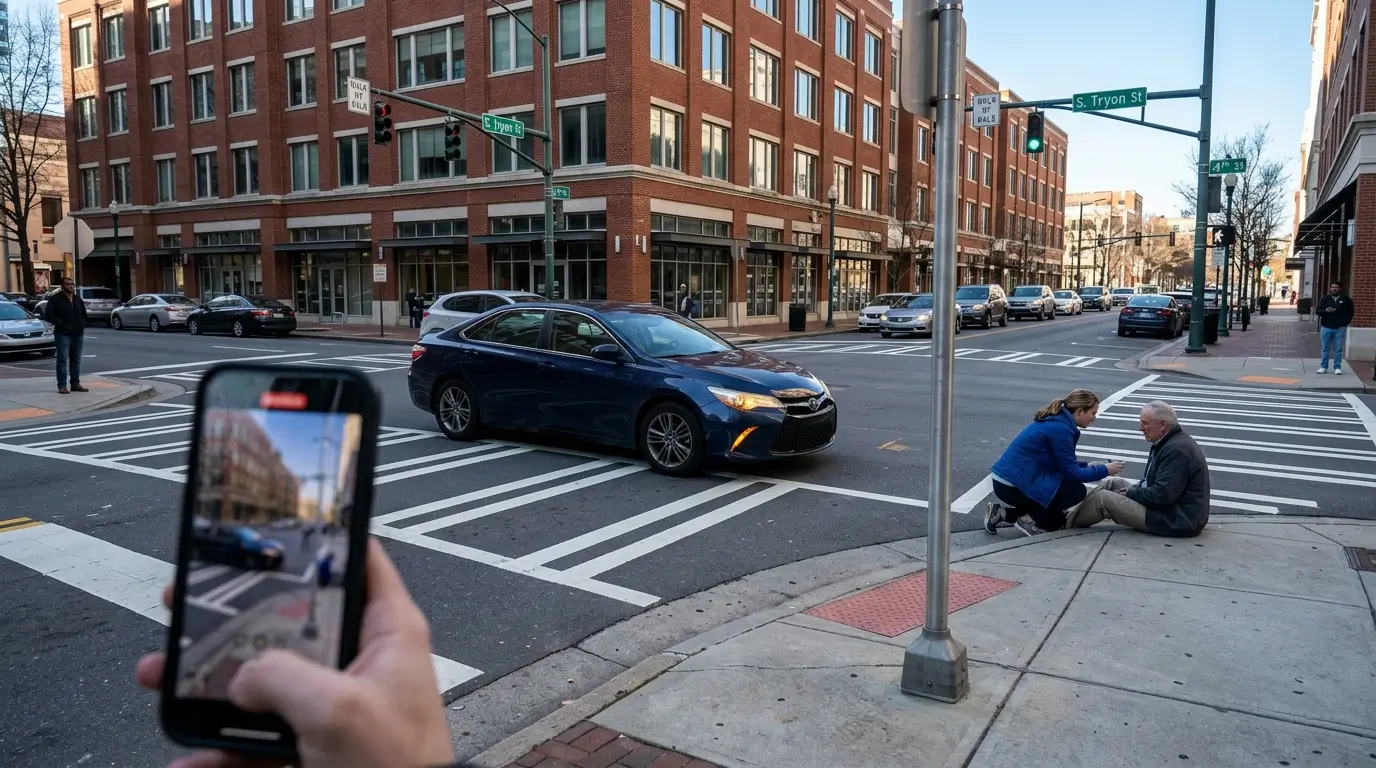
If you have been pedestrian hit by a car NC while walking, the existing fear of injury will be compounded by the confusing nature of the accident and how to navigate through the legal process to pursue compensation for your injuries.
The principle that governs all North Carolina personal injury cases where someone has been injured due to another person’s negligence (in this instance, while walking) is based on the premise that if the insurance company of the negligent party finds even a small degree of blame to be attributed to you, your ability to file a pedestrian injury claim against the negligent party will be eliminated.
This article discusses the rights you have under North Carolina law as an injured pedestrian, explains how fault is determined in North Carolina, and outlines what you can do to help yourself and make sure your case is successful.
I am Robert Tatum, an attorney at law from Tatum and Atkinson Law Firm. Our firm has been working as a federally funded law firm since 2006, and has over 65 years of combined experience in handling pedestrian accidents in North Carolina. Anyone who has been hit by a vehicle while walking in North Carolina will find that our firm is prepared to go to court, as we are knowledgeable regarding how to successfully advocate for you!
What Will Happen If a Car Hits You as a Pedestrian in NC
However, when a car hits a pedestrian, the results may be more serious than other forms of road accidents. Some critical factors play key roles in managing these accidents, such as:
You Actually Have a Legal Claim Against the Driver’s Insurance Policy
North Carolina is an at-fault state, which means that the insurance of the at-fault driver is responsible for paying out for your damages. In such cases, you, being a pedestrian and an accident victim, can claim that the insurance company cover your expenses through a pedestrian injury claim.
Why Such Cases Are Very Severe
There is nothing that separates a pedestrian from a car except for the body of the pedestrian himself or herself. It was reported by the CDC that in 2022, there were 8,000 deaths related to accidents when pedestrians were involved; that makes one death every 64 minutes. One in five people who died in traffic accidents in 2022 was a pedestrian.
Causes for Common Pedestrian Accidents
In most cases of pedestrian accident North Carolina, negligence or impatience of drivers is the accident incidents in cause, such as distraction, failure to yield, turning across the crosswalk without checking, speeding, and driving under the influence. Poor visibility plays a role, too; the majority of pedestrian deaths occur at night. Other causes include drivers reversing out of driveways and drivers proceeding with a right-on-red without checking.
North Carolina Laws Governing This Issue
Ascertaining liability in a pedestrian accident involves an analysis of the laws related to roadway conduct. The following is a list of some of these laws regarding who should yield right-of-way:
Where the Driver Should Yield
As provided in N.C.G.S. § 20-173, when traffic lights are not working, a driver should yield to pedestrians who are walking in any marked and unmarked crosswalk at an intersection; also, drivers leaving driveways and alleys should yield to pedestrians on sidewalks, which is key in any crosswalk accident North Carolina case.
Where the Pedestrian Should Yield
Both sides have duties. As stated in N.C.G.S. § 20-174, pedestrians crossing a street anywhere but the crosswalk should yield to vehicles; also, pedestrians who are crossing streets where there are posted pedestrian signals should yield.
Crosswalks You Cannot See
It’s the least understood portion of the statute. An unmarked crosswalk accident North Carolina can occur at most intersections where the natural extension of the sidewalk across the road would occur, despite the lack of any marking or signs. The duty of a driver to yield is no less than at a marked crosswalk.
The 1 Percent Rule And How It Affects You
In North Carolina and a few other states, contributory negligence pedestrian law means that if you are even 1 percent responsible for your injury, you will not receive any money from the other party, regardless of how much the other party was at fault. Insurance companies know that this is a possibility in North Carolina and will attempt to use any reason they can think of to place 1 percent or more negligence upon the injured pedestrian, such as:
- the pedestrian was jaywalking
- wearing dark clothes
- checking their smartphone
- or walking when the pedestrian had a “Do Not Walk” signal at an intersection.
A Violation Does Not Mean a Pedestrian Is At Fault
And here is what insurers are not keen on telling everyone: a violation of the statute does not equate to contributory negligence pedestrian per se for pedestrians. It is a matter of fact, and a driver needs to exercise due diligence and maintain a reasonable lookout anyway.
The Last Clear Chance Lifeline
Despite the pedestrian’s negligence, there is a possibility that he or she could be entitled to compensation under the last clear chance principle. If the driver spotted, or should have spotted, the pedestrian and had enough time and means to prevent the collision, but did not, he or she would be responsible for the accident even if the pedestrian made the mistake.
Special Consideration for Children
Children are not expected to make decisions like adults. There are many cases where children below the age of seven cannot be considered contributorily negligent, a fact that is vital in case a child runs out onto the street and sustains injuries from such negligence.
Pedestrian Injuries
Due to the lack of protection of the vehicle, pedestrians experience the full strength of the collision and also the subsequent impact on the ground. Typical types of injury include:
- traumatic brain injuries and concussions
- injuries to the spinal cord
- which could lead to paralysis
- fractured legs
- Pelvis
- arms
- organ damage
- blood loss
- injuries to muscles
- Ligaments
- and tendons.
What Should You Do if You Have Been Hit by a Car?
It is vital for any pedestrian involved in an accident to know about the right actions to take to determine how successful their recovery process will be. These include:
Seek Immediate Medical Attention
Visit the doctor even if you think that everything is fine. Adrenaline conceals injuries, and those that are dangerous for your life, such as brain hemorrhage and internal bleeding, will appear after several hours. Quick medical documentation will link your injuries to the accident.
Create the Documentation on the Spot
Try to call the police yourself, write down the name of the driver and his insurance information, and take pictures of the spot where the accident happened, of the vehicle, and of your injuries. If you are unable to do that, ask someone nearby to do it immediately.
Do Not Blame Yourself or Speculate
Just tell the truth to police officers and insurance companies. Your casual remark, “I did not see the car,” will be used by them as the 1%. Do not give the insurance company of the driver a recorded statement without consulting an attorney.
Evidence, Insurance Coverage, and Compensation
Here is all that you need to know regarding the evidence and insurance coverage and compensation regarding a pedestrian accident.
Proof that Succeeds for Pedestrian Injury Claims
The best pedestrian injury claim cases are based on objective evidence such as video from nearby surveillance cameras or from traffic cameras; witness testimony; the police report and diagram; and accident reconstruction indicating that the driver had ample time to stop.
Insurance Coverage, Uninsured Motorists, and Hit-and-Runs
In most situations, you’ll be filing a claim with the driver’s liability insurance. However, if the driver drove away from the scene or had no insurance, your own (or a family member’s) uninsured motorist insurance might cover your claim. North Carolina law requires this in auto insurance policies.
Compensation Available to You
Among other forms of compensation that you may recover are payments for medical expenses past and future, lost income and diminished earning capacity, pain and suffering, continuing care, and permanent disability. If you’ve lost a family member due to an accident, you may bring a wrongful death claim.
Limitations on Filing
As per N.C.G.S. § 1-52, your statute of limitations to bring an injury claim is three years from the date of the accident. A wrongful death claim can only be filed within two years.
The Way an Attorney Defends a Pedestrian’s Case
Pedestrian accident North Carolina cases rise and fall by way of the 1% rule, and therefore, the job is all about establishing liability before the insurance company puts together its case.
An NC pedestrian accident lawyer works swiftly to get the camera footage from the intersection, along with the police sketch and witnesses, and calls in a reconstructionist to prove that the driver could have avoided the accident and invokes the last clear chance where applicable.
We manage the adjuster to make sure that a slip of the tongue does not end your case.
Hit by a Car in North Carolina While Crossing the Street? Discuss Your Situation With Tatum & Atkinson.
You’ve been hurt, your medical expenses are mounting, and the insurance company for the driver may already be suggesting that you were somehow responsible. You need to know where you stand in a state where just a smidgen of responsibility will wipe out your claim, and that is something you can find out without any cost.
The Heavy Hitters have been fighting for injured pedestrian hit by a car NC victims in North Carolina since 2006, with an office in Raleigh at 702 Glenwood Avenue. They know North Carolina’s crosswalk laws and the 1% rule, as well as the last clear chance and what it takes to secure the video evidence and witnesses that demonstrate who is at fault.
Give us a call at (800) 529-0804 to schedule a free consultation. We work on contingency, meaning there is no charge unless we win for you, and the first call is free of charge.
Frequently Asked Questions!
I was jaywalking when I got hit. Do I have any case?
It is possible. The act of crossing outside a crosswalk will be considered against you according to the contributory negligence pedestrian rule; however, crossing outside a crosswalk is not a per se rule of negligence, and your recovery under the last clear chance doctrine is still possible if the driver could have avoided hitting you.
The driver who hit me had no insurance and fled. Now what?
You are still covered. An uninsured or hit-and-run accident victim will be able to sue for uninsured motorist coverage under their insurance policy. It is mandatory for drivers to buy this kind of coverage in North Carolina.
What does it cost to hire a pedestrian accident lawyer?
No up-front costs. An NC pedestrian accident lawyer works on contingency, and the initial consultation is free.
How long do I have to file a pedestrian accident claim in NC?
Typically, three years after the date of your accident for an injury case, and two years for a wrongful death case. Delay will put you at risk of losing both the proof and your right to file a suit.
Will my pedestrian accident case go to trial?
While most cases are settled out of court, having your ducks in a row when the insurance company resorts to contributory negligence pedestrian can be the key to success.
