What Is The Value In Having A Dashcam In My Car In Virginia?

Key Highlights:
What Is The Value In Having A Dashcam In My Car In Virginia?
- Dashcam use in Virginia can provide you with a valuable piece of evidence in case of an auto accident. The video evidence is objective, time-stamped, and can show who is at fault for the crash, help prove against false claims, and greatly support your personal injury case.
- Dashcams are legal to use under Virginia Code § 46.2-1054 as long as they do not obstruct your view while you are driving.
- Virginia is considered a “one-party consent” state. You may legally record audio inside your car as long as you are one of the parties to the conversation, without notifying your passenger(s).
- Dashcam footage of a car accident in Virginia will allow Virginia’s insurance companies to resolve the claims faster, more accurately, and often at a higher settlement compared to claims where the only evidence is witness statements.
- The dashcam footage could also be damaging to you due to showing you being distracted while driving. You should always speak to a car accident lawyer in Virginia before giving footage to insurance companies.
Virginia sees thousands of accidents each year. Fault disputes are by far the most popular reason why an injury claim is either delayed or denied. A dashcam is one of the most useful items a Virginia driver can have, both for safety and as a legal aid. So if you ask: What is the value in having a dashcam in my car in Virginia? The value, however, extends beyond convenience alone. Under the right conditions, just one small camera could be the factor distinguishing between receiving your full settlement and having to fight a lengthy legal battle to obtain it.
I’m Robert Tatum, an attorney with Tatum & Atkinson Law Firm, who has represented clients throughout Virginia for just over 20 years, dealing exclusively with car accident claims. I’ve seen how the use of dashcam video has resolved disputes immediately rather than through months of litigation. Our veteran-owned firm was founded in 2005 and brings to bear over 65 years of car accident evidence in Virginia in all types of cases. We know how to use that evidence in the most effective manner possible. And, we will fight for you.
Is Using a Dashcam Legal in Virginia?
Virginia allows the use of dash cams, and no law bars their use in the state. However, consideration should be given to where the camera is mounted, as per Virginia Code § 46.2-1054 (code restricting what may block the view of the driver).
The best practice for mounting a dash camera is near the rear view mirror, making sure it does not block the driver’s view of the road. Since this type of mounting will usually be the most commonly used, it is likely to be a safe way of mounting a dash camera.
Do I Have to Tell Someone I Am Recording Them in Virginia?
Virginia has a one-party consent law regarding audio recordings – meaning that if you are one party to an audio recording being made, then you may make the audio recording without telling the other party/parties that you are making the recording inside your vehicle (assuming they didn’t see the recording device).
Therefore, if you are recording audio of passengers who are not part of an audio recording, you run the risk of legal issues unless you inform those passengers that you will be recording audio in your vehicle (especially if you are using the dashcam to record for commercial driving, e.g., ridesharing).
How Dashcams Help After a Car Accident in Virginia
In the event of a vehicle-related incident in Virginia, dash cams provide video shot in real time; they can be used to establish liability issues arising as a result of inconsistencies in witness testimony, memory recall problems, and/or a lack of detail supporting law enforcement reports.
Clear Fault Evidence
Records exactly how the crash occurred, reducing disputes.
Record Important Facts
Captures speed, position in the lane, stop lights, and the behavior of the driver.
Provide Evidence to Support Legal Claims
A comprehensive video helps to eliminate discrepancies between witness testimony and police reports, playing a role in increasing the value of dashcams in car accident claims.
Provide Support to the Case When Contributory Negligence is an Issue
A video is helpful to show that the person isn’t 1% to blame for the collision.
Establish the Violation
A good video can be evidence of a driver running a red light, changing without signaling, or failing to yield to a pedestrian.
Is Dashcam Footage Admissible in Virginia Courts?
Yes, Virginia’s court systems consider dashcam videos as documentary evidence, and thus, they must be authenticated and relevant to the incident in question, just like any other form of documentary evidence.
- The dashcam footage must not have been altered or tampered with, must have been recorded correctly, and must be directly related to the case.
- Dashcam video can be one of the strongest types of vehicle accident evidence you can have in a personal injury case when it is protected and qualified by your personal Virginia car accident attorney as a valid and appropriate form of evidence.
You should also act quickly if you want to retain videos of what happened. Most dash cams record in continuous loops, so they may write over old video within hours (or possibly days) after the incident; as long as the video is preserved and not altered, the court will want to see it, so first, remove the SD card (memory card) from the dash cam and back up the SD card’s files to an alternate device(s).
Avoid deleting anything from the SD card until you get a copy of the dash cam video to your attorney, because getting a copy of the dash cam video to your attorney before giving it to anybody else, including the police or insurance companies, is critical.
Dashcam and Insurance Claims in Virginia
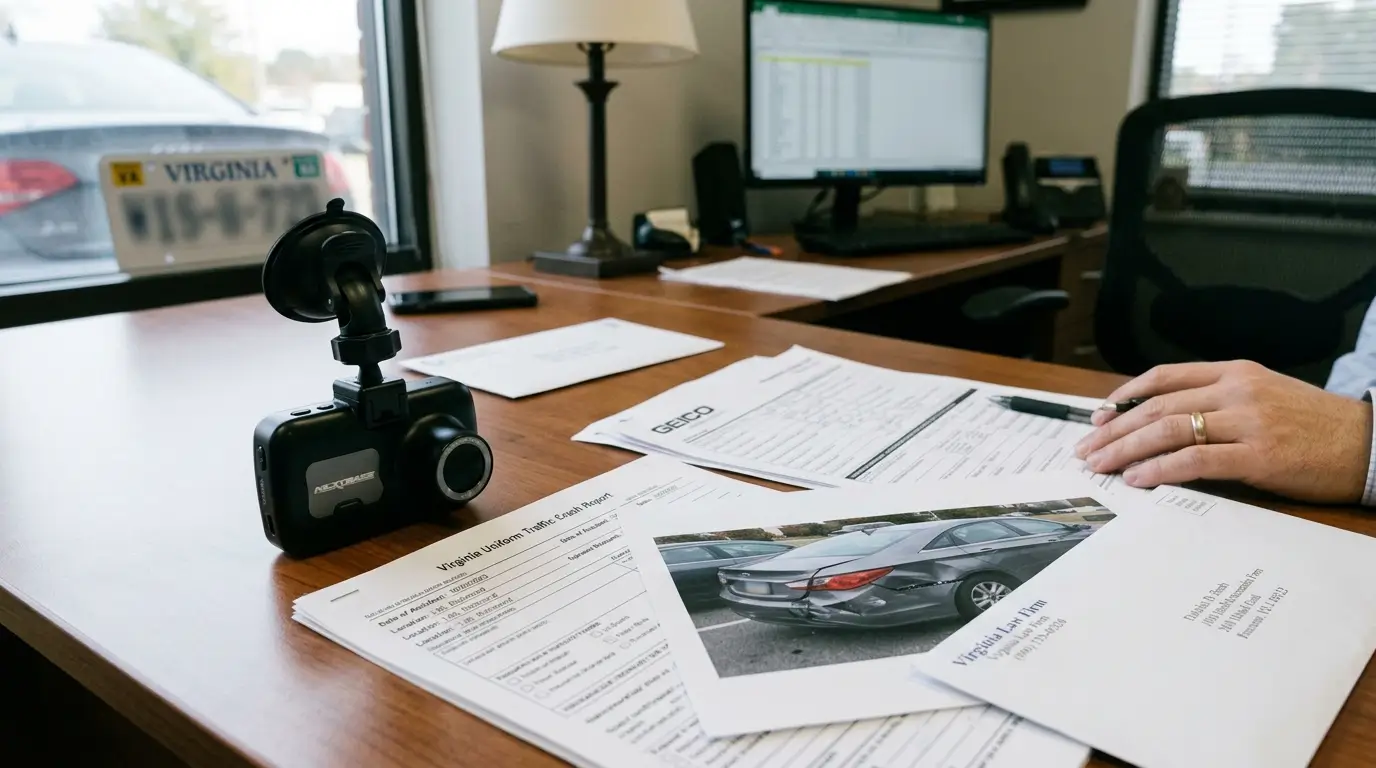
A common question is, “Can dashcams help with insurance claims in Virginia?” Insurance adjusters determine fault based on the evidence available. If the sequence of events is clearly shown on the dashcam footage of a car accident in Virginia, it can significantly reduce the adjusters’ ability to discount your claim or decide on a shared fault basis.
Claims that are supported by this type of evidence can generally be settled more quickly than claims without video evidence, and video evidence provides a greater likelihood of translating into a higher settlement amount due to the clearer documentation of fault.
Will My Insurance Go Down If I Have a Dashcam?
Some insurance companies in Virginia are offering drivers who use dash cams, especially those who are using them for commercial/fleet vehicles, small premium discounts for using this technology because it promotes better driving habits.
However, the availability of discounts for each driver varies significantly by insurance company. The greater financial value of using a dash cam is the protection it provides against inflated claims or fraudulent accusations that may otherwise increase your rates after a disputed accident.
5 Key Benefits of Using a Dashcam While Driving in Virginia
Virginians can utilize dash cameras as protection not only by providing proof during an accident but also by averting possible fraud or fake claims through documentation of all events that took place while parked as well as ongoing recordings of everything occurring before and after an accident.
1. Protection from parking incidents
Recording incidents where another driver hits or damages your car and leaves without stopping, including hit-and-run, vandalism, or sideswiping incidents when your car is parked.
2. Evidence from hit-and-run accidents
Helps identify who damaged your vehicle and did not stop to provide details.
3. Fraud Prevention
Helps deter fraudulent accidents and exaggerated claims of injury.
4. Insurance Claim Support
Provides clear, documented evidence to back the recovery of your insurance claim.
5. Deterrent of driver behavior
Decreases the likelihood that your vehicle will be a target for fraud.
Limitations of Dashcam Footage in Virginia Legal Cases
Although dashcam video can help with your Virginia accident claim, it’s far from being the best piece of evidence to support your case. Dash cams have been known to miss important angles, have quality issues, and may also contain evidence that could work against you as the driver (depending on what was captured).
- Camera views are limited: You could miss side and back impacts clearly.
- Blind spots: By having one camera, you potentially miss some of the important parts of the collision.
- Video quality may be poor: Video lighting, weather, or lens can affect how clear the video is.
- The event could be partially recorded: The recording of one camera may not capture all of the events that took place.
Can be used against you! Attorneys from the other side could take your own driving style and make it look bad to the jury.
Should You Share Dashcam Footage Immediately After a Crash?
Without consultation with an attorney, handing over dashcam video footage is very risky. Virginia law allows for mandatory disclosure of evidence that is relevant to the litigation at some point in time; however, if you voluntarily provide the video footage without consultation with an attorney, you may be making a risky decision.
An experienced car crash lawyer will review Virginia dashcam evidence thoroughly before you provide it to another party to determine what the video shows, what it does not show, and how the dashcam footage fits within the totality of the circumstances surrounding liability in your particular case.
Is Your Dashcam Draining Your Car Battery?
Many Virginia drivers are concerned that their dashcam(s) drain their car battery. Dashcam(s) that are used in parking mode will use power from the vehicle battery continuously, and, on older cars or cars with small batteries, using this mode can result in your battery becoming discharged if the vehicle is parked for extended periods of time.
A good way to hardwire a dashcam to the electrical system of a vehicle to eliminate this concern is to use a ‘fuse tap’ with a low-voltage shutoff circuit. The fuse tap allows the dashcam to continuously use power when in parking mode, and the low-voltage cutoff circuit will turn off the dashcam before the battery gets to a point where it will not allow the vehicle to be started.
Case Study: Dashcam Footage and Fault Determination in a Virginia Car Accident
In Virginia Beach, there was a personal injury case where liability was contested between two parties (plaintiff and defendant). The plaintiff produced dashcam footage from the plaintiff’s vehicle, which demonstrated that the defendant followed too closely and traveled over the speed limit when they rear-ended the plaintiff’s vehicle at a controlled intersection. The video was successfully introduced into evidence and authenticated before the civil trial.
Result
Eventually, the defendant’s claim of contributory negligence was defeated by the dashcam video, and the case was settled above the insurer’s original offer. The plaintiff’s Virginia car accident attorney credited the dashcam video as the key component of the successful resolution of the case. The Virginia Courts Case Information System keeps track of civil settlements in Virginia, and personal injury claim dashcam footage evidence can determine the outcome of an entire personal injury claim.
Should You Install a Dashcam in Your Virginia Vehicle?

Virginia’s contributory negligence laws are very strict, and so a dash cam is extremely valuable. Video evidence can provide legal protection to drivers, financial protection, and greatly strengthen an accident claim. If you have been involved in a motor vehicle accident in Virginia and have video footage from a dashcam or need help with how to deal with evidence from the crash, then Tatum & Atkinson can help you.
We work on all of the car accident cases that we take on a contingency basis, so you will not have to pay for our services unless we win. You should call us today at (800) 529-0804 for a free consultation. As a veteran-owned firm, we have proven that we know how to build winning legal cases and take advantage of all of the evidence we can get our hands on.
FAQs: What Is The Value In Having A Dashcam In My Car In Virginia?
What happens if both drivers have dashcams?
Dashcam footage may provide two different recordings that could be used in the investigation as evidence to determine liability in your case; your car accident lawyer in Virginia will examine both of these recordings and use them to build a case for you based on what they demonstrate collectively about who is at fault.
Can dashcam footage lower my insurance claim?
Yes, if it demonstrates your own unsafe driving. However, before discussing your dashcam footage of a car accident in Virginia with any insurance company, you should first discuss this with the Virginia car accident attorney that you are retaining.
Is dashcam evidence used in court cases?
Yes. The answer is absolutely yes to this question, “Is dashcam evidence admissible in Virginia courts?” by judges and juries who consider this type of evidence both objective and reliable as documentary evidence.
How do I use dashcam footage after a crash?
You must preserve the original file immediately, create a data backup, and provide a copy of the filing to your car accident attorney before showing it to law enforcement or the insurance companies. You cannot alter the information contained in the original videotape.
Can a dashcam protect me from false claims?
Yes, dashcam footage can be used under Virginia traffic accident evidence rules to refute any question of credibility with respect to fabricated or exaggerated claims made against you by the opposing driver and/or insurance company.
